
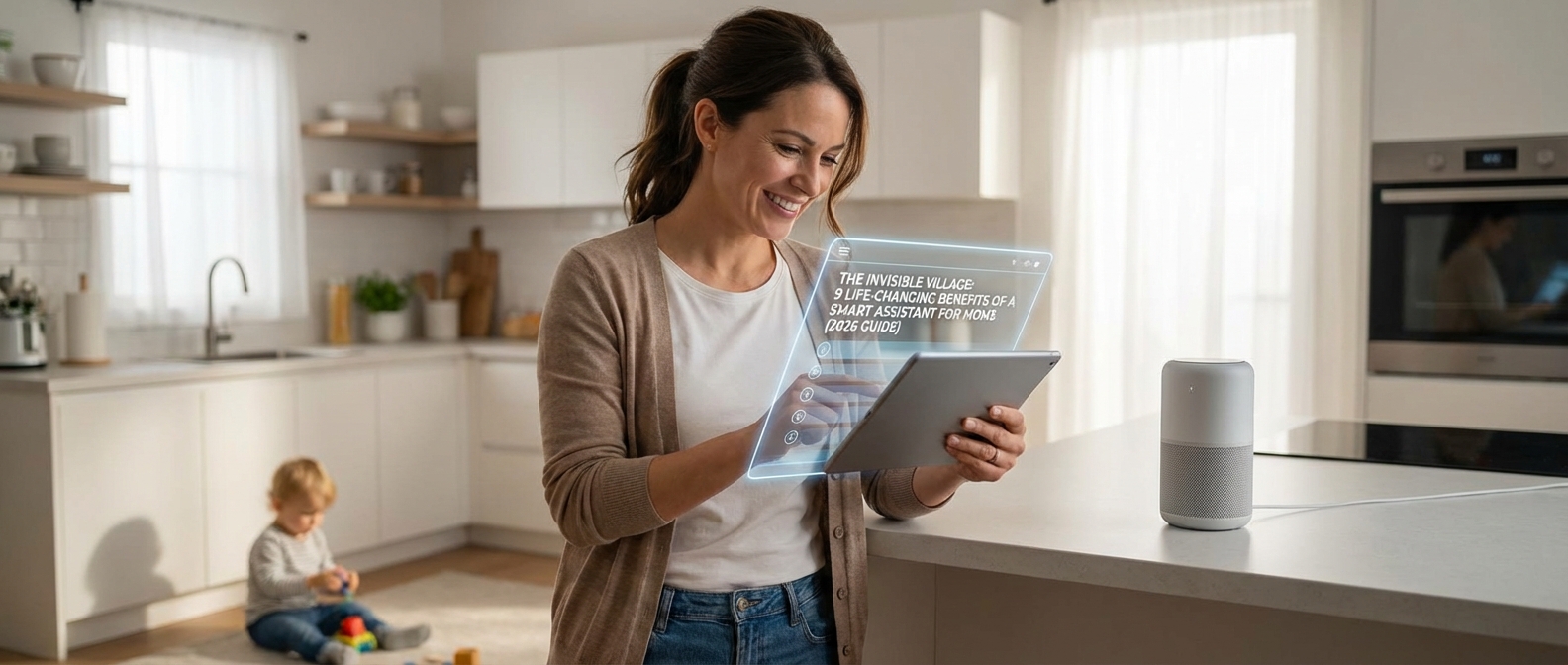
Introduction: Why Every Mom Needs a 'Digital Village' in 2026
Introduction: Why Every Mom Needs a 'Digital Village' in 2026
A "Digital Village" serves as a critical cognitive offload for modern mothers, transferring the overwhelming weight of invisible labor and household logistics to proactive AI parenting tools. By 2026, smart assistants have evolved from reactive gadgets into predictive partners, essential for automating routine tasks, managing family schedules, and reclaiming hours of lost time.
The Crushing Weight of the Mental Load
Motherhood has never been just about the physical tasks of feeding, clothing, and driving. It is the relentless, silent hum of project management. You aren't just buying groceries; you are tracking inventory, meal planning for picky eaters, and budgeting simultaneously. This is the mental load—the endless "to-do" list running in the background of your brain that prevents true relaxation.
In the past, technology promised to help but often added to the noise. Today, the smart home 2026 ecosystem is different. We have moved beyond simple automation into genuine anticipation.
From Timer to Partner: The AI Evolution
If you still think of a smart speaker as a kitchen timer or a weather reporter, you are living in the past decade. Generative AI has transformed these devices from reactive tools into proactive members of the household. They no longer wait for you to remember; they remember for you.
Here is how the landscape has shifted:
| Feature | The Old Way (2020s) | The Digital Village (2026) |
|---|---|---|
| Interaction | You shout specific commands ("Set timer for 10 mins"). | AI infers intent ("Start the dinner routine"). |
| Context | Zero memory of previous conversations. | Remembers family preferences, allergies, and schedules. |
| Proactivity | Passive; waits for input. | Proactive; suggests ordering diapers before you run out. |
| Integration | Siloed apps that didn't talk to each other. | A unified system managing heat, security, and chores. |
Building Your Infrastructure
You cannot pour from an empty cup, yet society expects moms to be an infinite well. Adopting a digital village isn't about being "techy"; it is about survival and efficiency. Whether you are setting up complex automations or simply deciding between Alexa vs. Google Home for Families, the goal is identical: outsourcing the cognitive burden.
By delegating the invisible labor to a machine, you aren't parenting less; you are freeing up mental bandwidth to parent better. When you aren't stressing about whether the thermostat is set correctly or if the back door is locked, you can actually be present with your children.
In this guide, we will explore exactly how a smart assistant acts as the village we were promised but never given, focusing on three critical pillars:
- Saving Time: Automating the mundane.
- Saving Money: Energy efficiency and smarter shopping.
- Saving Sanity: Reducing decision fatigue.
1. Offloading the Mental Load: Your Second Brain
1. Offloading the Mental Load: Your Second Brain
Cognitive offloading is the psychological process of reducing mental demand by using external tools to store information, rather than relying solely on memory. For mothers in 2026, a smart assistant acts as this critical external drive, instantly capturing fleeting tasks—appointments, grocery needs, medication schedules—and storing them securely. This immediate transfer allows the brain to release the persistent anxiety of "remembering," freeing up mental bandwidth for decision-making, creativity, and emotional presence.
The Science of "Letting Go"
The mental load is often invisible, yet it is heavy. Psychologists refer to the "Zeigarnik Effect," which suggests that uncompleted tasks occupy more cognitive space than completed ones. When you carry a mental to-do list, your brain remains in a state of low-grade hypervigilance.
By verbalizing a task to a smart assistant the moment it crosses your mind, you close the loop. The assistant doesn't just record the data; it assumes the responsibility of the prompt. This shift is fundamental. You are no longer the keeper of the schedule; you are the manager of the system.
The Power of the Shared Ecosystem
The most significant friction point in household management is information asymmetry—when Mom knows the schedule, but no one else does. Smart assistants dissolve this barrier through the shared family calendar.
When you dictate an event to your assistant, it doesn't just sit in a silo. It propagates to the smartphones of your partner and older children. The mental load transforms from a solo burden into a transparent, shared resource.
Here is how smart assistants translate invisible mental labor into actionable data:
| Mental Load Category | The Old Way (Internal Storage) | The Smart Way (Voice Command) |
|---|---|---|
| Event Tracking | "I must remember the pediatrician appt is moved to Tuesday." | "Reschedule the pediatrician to Tuesday at 3 PM on the shared family calendar." |
| Micro-Management | Nagging family members to complete daily chores. | Setting recurring reminders announced via smart speakers in specific rooms. |
| Supply Chain | Standing in the aisle trying to recall if you need detergent. | "Add detergent to the shopping list" the moment the bottle feels light. |
| Critical Timing | Stressing about turning off the oven or moving laundry. | "Set a timer for 20 minutes for the laundry." |
Automating the Mental Safety Net
In 2026, the technology has evolved beyond simple reactive commands. The true power lies in proactive assistance. You can now configure your system to anticipate needs based on the time of day or location.
For example, morning chaos can be mitigated by pre-programmed sequences that announce the weather, review the day's calendar, and remind kids to pack their gym bags. If you are looking to streamline your mornings further, check out our guide on 21 Best Smart Home Routines for Moms in 2026 [The Ultimate Sanity Saver].
By trusting the technology to handle the minutiae, you reclaim the mental clarity required to handle the complexities of parenting that no algorithm can solve.
Mastering the Family Calendar via Voice
Mastering the Family Calendar via Voice
Mastering your schedule via voice commands is the single most effective way to reclaim mental bandwidth in 2026. By integrating hands-free entry into your daily workflow, you eliminate the friction of stopping to unlock a phone, ensuring that every playdate and pediatrician appointment is captured the moment you think of it.
The Hands-Free Advantage
The mental load of motherhood often peaks when your hands are busiest. You might be wrist-deep in meal prep when a reminder pops into your head, or merging onto the highway when the school nurse calls. In the past, you had to rely on memory. Now, you rely on voice.
- While Cooking: Instead of washing your hands to type, simply say, "Add Leo’s soccer practice every Tuesday at 5 PM starting next week." The assistant parses the recurrence pattern instantly.
- While Driving: Safety is paramount. Utilize your car’s integration to dictate, "Schedule Dr. Smith for a wellness check on February 12th at 10 AM," without taking your eyes off the road.
This fluid approach to schedule management transforms a fragmented to-do list into an organized, digital reality.
2026 Intelligence: Conflict Detection
The true power of modern smart assistants lies in their ability to understand context, not just dictation. In 2026, the software acts less like a typewriter and more like an executive assistant.
If you attempt to schedule a playdate during a time slot already occupied by a dentist appointment, the assistant will now intervene audibly: "You have two events at 4 PM. Would you like to reschedule?" This real-time conflict detection prevents the dreaded double-booking that often derails family weekends.
To understand which platform offers the most intuitive calendar management for your specific needs, check our comparison: Alexa vs. Google Home for Families (2026).
Evolution of Calendar Commands
The leap in natural language processing has made interacting with your calendar significantly more efficient this year compared to previous generations.
| Feature | The Old Way (2023) | The 2026 Smart Standard |
|---|---|---|
| Complex Scheduling | Required multiple commands or manual editing. | "Add swimming lessons every other Thursday until May." |
| Conflict Resolution | Silent overbooking; user discovers errors later. | Active verbal warning: "That conflicts with Piano Lessons." |
| Family Context | Generic calendar entry. | Identifies family members ("Add to Sarah's calendar"). |
| Location Intelligence | Basic time entry. | "Leave at 3:30 PM to account for traffic to the soccer field." |
By leveraging these advanced voice capabilities, you stop managing the software and start letting the software manage the logistics.
The Never-Ending To-Do List
The Never-Ending To-Do List
The mental load is the invisible weight dragging modern mothers down; it isn't the execution of chores that causes burnout, but the constant, low-level anxiety of remembering them. The "brain dump" method leverages your smart assistant to instantly capture fleeting thoughts, transforming a chaotic mind into an organized digital to-do list. By vocalizing tasks the second they arise, you transfer the cognitive burden from your biological memory to the cloud.
In 2026, smart assistants have evolved beyond simple reminders into context-aware task management powerhouses. You are in the middle of a diaper change and notice the wipes are running low. You don’t need to wash your hands, find your phone, and unlock an app. You simply say, "Add wipes to the shopping list." The task is captured. The thought is released. Your mental RAM is freed up for what actually matters.
Whether you favor Amazon or Google—a choice often dictated by your specific household needs as detailed in our Alexa vs. Google Home for Families (2026) comparison—the core benefit of the brain dump remains consistent: friction reduction.
Mental vs. Digital: The Reliability Gap
The human brain is designed for processing, not storage. Relying on memory for household logistics is a setup for failure. Here is how a voice-activated system compares to traditional methods:
| Feature | Mental Checklist | Paper Planner | Smart Assistant (Voice) |
|---|---|---|---|
| Capture Speed | Instant | Slow (requires location) | Instant (hands-free) |
| Reliability | Low (prone to forgetting) | High (if you look at it) | High (proactive reminders) |
| Mental Load | Heavy (constant refreshing) | Moderate | Zero (dump and forget) |
| Shareability | Impossible | Low (physical access needed) | Instant (syncs to partner's phone) |
Mastering the Art of the "Brain Dump"
To make this system work, you must trust the technology enough to let go. Effective task management in a smart home relies on immediate action. Do not wait.
- Categorize on the Fly: Don't just make one list. Command your assistant to "Add pediatrician appointment to my Calendar" or "Add batteries to the Hardware Store list."
- Offload Recurring Thoughts: If you worry about forgetting trash day every week, automate it. Set a recurring announcement.
- Integrate the Partner: The most powerful aspect of the digital list is visibility. When you dump a task into the shared ecosystem, it becomes accessible to your partner immediately, dismantling the "I didn't know we needed that" excuse.
By externalizing your to-do list, you aren't just getting organized. You are silencing the nagging voice in your head that whispers you are forgetting something. You probably were. Now, you won't.
2. The Hands-Free Household Manager
2. The Hands-Free Household Manager
A smart assistant in 2026 acts as a proactive Chief Operating Officer, leveraging predictive AI to handle household logistics before you even notice a shortage. By integrating with inventory sensors and analyzing historical consumption data, these systems transition the mental load of restocking from your brain to the cloud, ensuring essentials arrive exactly when needed without a single manual command.
From Reactive Lists to Predictive Supply Chains
The days of shouting at a smart speaker to "add milk to the list" are rapidly becoming obsolete. In 2026, the technology has evolved from passive listening to active anticipation. Your assistant now understands the "burn rate" of your household consumables.
It knows you go through a box of diapers every 16 days. It tracks that the dishwasher has run 40 cycles, meaning the detergent pods are critically low. Instead of waiting for you to discover an empty box, the system drafts a smart shopping cart for your approval or, if enabled, executes a "Zero-Click" order. This is the difference between managing a crisis and managing a supply chain.
For a deeper dive into structuring these automated workflows, review our guide on the 21 Best Smart Home Routines for Moms in 2026 [The Ultimate Sanity Saver].
2026 Feature Comparison: The Evolution of Restocking
The shift from manual inputs to predictive analytics saves the average parent 4+ hours per month. Here is how the technology stacks up:
| Feature | The Old Way (2024) | The 2026 Standard (Predictive AI) |
|---|---|---|
| Inventory Tracking | Manual visual checks; reactive additions. | Sensor-fusion: Weight sensors in pantries & cycle-counting appliances. |
| Order Execution | User must initiate checkout. | Autonomous Fulfillment: System orders based on price drops and delivery windows. |
| Budget Management | Static monthly limits. | Dynamic Arbitration: AI swaps brands dynamically to stay within budget during inflation spikes. |
| Delivery Logistics | Packages left on porch randomly. | Secure Coordination: Syncs with smart locks/garage openers for in-home delivery. |
The Mechanics of Home Automation
True automation in 2026 extends beyond buying goods; it manages the physical flow of items into the home. Your assistant now aggregates orders from multiple vendors (Amazon, Walmart, local grocers) to minimize the number of deliveries, reducing the "cardboard mountain" in your entryway.
Furthermore, these assistants now cross-reference your family calendar. If the system sees a "Vacation" entry, it automatically pauses perishable subscriptions like meal kits or milk deliveries. This level of granular control ensures your home runs efficiently without your constant supervision, allowing you to focus on parenting rather than procurement.
Key capabilities of the 2026 Household Manager include:
- Expiration Alerts: Notifications when pantry items (tracked via RFID tags) are approaching their use-by date to reduce food waste.
- Price Arbitrage: The assistant scans multiple marketplaces instantly to secure the lowest price for recurring consumables.
- Substitute Intelligence: If your preferred brand of baby formula is out of stock, the AI suggests the closest nutritional match based on ingredient analysis, not just keyword matching.
If you are setting up your ecosystem from scratch to handle these advanced logistics, refer to How to Build the Ultimate Smart Home for Moms: The 2026 Setup Guide to ensure your hardware supports these predictive features.
Smart Grocery Shopping & Inventory
Smart Grocery Shopping & Inventory
Smart assistants in 2026 have evolved from passive note-takers to active supply chain managers for your home. By leveraging advanced grocery delivery integration, these systems monitor consumption patterns, predict needs based on your family’s habits, and automatically populate carts with local retailers like Walmart+, Kroger, or Amazon Fresh, ensuring you never run out of essentials again.
From Recipe to Doorstep
The most significant leap this year is context-aware ordering. You no longer need to list individual items. Instead, you simply say, "Add ingredients for lasagna to next week's order."
Your assistant instantly processes this command by:
- Analyzing the Recipe: Pulling your preferred lasagna recipe from your digital cookbook.
- Checking Inventory: Scanning connected pantry sensors or your digital inventory to see what you already have (e.g., "You have pasta, but need ricotta and ground beef").
- Cart Population: Adding only the missing items to your delivery cart.
This seamless connection between meal planning and purchasing removes the mental load of ingredient mathematics entirely. It transforms a 20-minute task into a 5-second voice command.
2026 Grocery Features Breakdown
The difference between using a standard shopping app and a fully integrated smart assistant is drastic. Here is how the technology stacks up:
| Feature | Standard App Manual Entry | AI-Assistant Integration (2026) |
|---|---|---|
| List Building | You type items one by one as you notice they are empty. | Assistant tracks usage and auto-adds items (e.g., "Detergent is low"). |
| Recipe Management | You cross-reference ingredients manually. | Command-based: "Get everything for Taco Tuesday." |
| Price Comparison | You check different store flyers. | Assistant scans local inventory for the lowest total cart price. |
| Fulfillment | You select a delivery window manually. | Aligns delivery with your calendar (e.g., "Schedule delivery for when I'm home"). |
Predictive Inventory Management
Beyond ordering, your assistant now manages waste. By tracking expiration dates on digital receipts, it can alert you when the spinach is about to wilt and suggest recipes to use it immediately. For moms juggling multiple schedules, this automated oversight is crucial.
If you are unsure which ecosystem handles these complex logistics best, we have compared the top contenders in our guide to Alexa vs. Google Home for Families (2026). Choosing the right platform determines whether your groceries arrive on time or get stuck in a digital cart.
Meal Planning Made Effortless
Meal Planning Made Effortless
Smart assistants in 2026 have transformed into proactive kitchen managers that eliminate decision fatigue by generating AI recipe suggestions based on real-time inventory. Rather than manually searching for ideas, you can leverage voice commands to instantly curate meals, generate shopping lists, and guide the cooking process without lifting a finger.
The "what's for dinner?" panic is obsolete. Picture this: it is 5:30 PM, and your fridge contains only random ingredients. You simply ask your smart speaker, "What can I cook with chicken and broccoli?" The AI doesn't just search the web; it filters results based on your family’s dietary restrictions and the spices it knows you have in the pantry. It presents a tailored option—perhaps a garlic soy stir-fry—and asks if you want to start.
The Hands-Free Kitchen Experience
Once you select a meal, the assistant enters hands-free cooking mode. This is critical for maintaining hygiene and sanity.
- Step-by-Step Dictation: The assistant reads one instruction at a time, waiting for your "Next" command.
- Multi-Timer Management: It automatically sets specific timers for different burners ("Set a 10-minute timer for the rice").
- Unit Conversion: Ask, "How many tablespoons in a quarter cup?" without wiping your hands.
If you are debating which ecosystem handles these kitchen workflows best, our guide on Alexa vs. Google Home for Families (2026) breaks down the specific display features of each.
Traditional vs. Smart Meal Prep
The efficiency gap between manual planning and AI assistance is widening.
| Task | Traditional Method | Smart Assistant Method (2026) |
|---|---|---|
| Idea Generation | Scrolling blogs for 20 mins. | Instant, inventory-based AI recipe suggestions. |
| Cooking | Constant phone checking; messy screens. | Hands-free cooking with voice prompts. |
| Groceries | Writing lists; forgetting items. | Voice-add items immediately when empty. |
| Timing | Burning food while distracted. | Auto-managed timers for every pot. |
This seamless integration allows you to reclaim roughly 3-4 hours per week. By offloading the cognitive load of meal management to your invisible village, you turn the kitchen back into a place of connection rather than stress.
3. The Ultimate Routine Enforcer
3. The Ultimate Routine Enforcer
The most exhausting part of parenting often isn't the physical labor; it is the emotional friction of being the "bad guy." You spend hours repeating instructions, negotiating minutes, and policing behavior. A smart assistant changes this dynamic entirely by becoming the impartial third-party authority in your home. It doesn't nag; it simply executes.
By offloading the enforcement of daily schedules to AI, you remove yourself from the conflict loop. The assistant triggers the transition, and you get to support your child through it, rather than being the force they are fighting against.
Taming the Morning Chaos
Morning chaos usually stems from a lack of temporal awareness in children. They don't realize that "five minutes" is actually passing. Instead of shouting from the kitchen, program your assistant to manage the countdown.
- 7:00 AM: Bedroom lights slowly brighten to 50% (simulated sunrise).
- 7:30 AM: A cheerful announcement plays: "Breakfast is on the table."
- 7:50 AM: A specific warning chime sounds: "Shoes and backpacks check. Bus leaves in 10 minutes."
When the speaker announces it’s time to go, the urgency comes from the device, not your voice. For a deeper dive into setting these up, read our guide on 21 Best Smart Home Routines for Moms in 2026.
Automating Screen Time Limits
Negotiating the end of video games or cartoons is a flashpoint for temper tantrums. Smart assistants eliminate the negotiation phase entirely. By integrating smart plugs or router controls, you can enforce screen time limits with surgical precision.
When the allotted time expires, the assistant doesn't ask the child to stop; it simply announces, "Screen time is over," and cuts power to the TV or pauses the specific device's Wi-Fi access. The screen goes black. The child can't argue with a router. You are no longer the villain who turned off the fun; the "system" did it.
Comparison: Human vs. AI Enforcement
| Feature | Mom Enforcing Rules | Smart Assistant Enforcing Rules |
|---|---|---|
| Consistency | Variable (tired, busy, distracted) | 100% Consistent (never forgets) |
| Child's Reaction | Negotiation, pleading, arguing | Acceptance (cannot argue with code) |
| Emotional Load | High (guilt, frustration) | Zero (passive observation) |
| Role | The Adversary | The Comforter |
The Frictionless Bedtime Routine
Resistance at night often happens because the environment doesn't match the expectation of sleep. A smart assistant curates the atmosphere to induce drowsiness long before you tuck them in.
A solid bedtime routine in 2026 involves multi-sensory cues. At 7:30 PM, the living room lights automatically shift to warm amber tones to stimulate melatonin. Simultaneously, high-energy playlists switch to ambient noise or audiobooks in the nursery. If you are struggling with younger children staying in bed, specific connected clocks are essential—see our recommendations in 17 Best Smart Home Devices for Toddlers in 2026.
By the time you walk into the room, the house has already signaled that the day is over. The assistant sets the boundary; you simply enforce it with a hug.
Streamlining the Morning Rush
Streamlining the Morning Rush
Mornings often serve as the day's primary friction point, characterized by lost socks, cold floors, and sleepy protests. A smart assistant transforms this chaos into choreography. By deploying a customized morning automation, you shift the burden of waking the household from your shoulders to your digital ecosystem, ensuring the day begins with momentum rather than resistance.
Imagine a wake-up sequence that respects biology and logistics simultaneously. At 6:45 AM, the blackout shades in the kids' rooms slowly rise while the smart bulbs gradually fade up to warm white, simulating a natural sunrise. This biological cue triggers cortisol release more gently than a jarring alarm clock.
As the household stirs, the automation evolves:
- 6:50 AM: The smart speaker reads the local weather report, signaling immediately whether it is a "boots" or "sneakers" kind of day.
- 6:55 AM: A curated playlist of upbeat music begins playing in the kitchen and hallway, setting an energetic tone.
- 7:15 AM: The music dips in volume, and a synchronized broadcast announces to all bedrooms: "Time to brush teeth and grab backpacks."
This consistency is vital for establishing a reliable kids routine. When the smart assistant issues the reminders, it depersonalizes the enforcement. You are no longer the "nagging parent" demanding speed; the house itself keeps the schedule, allowing you to focus on breakfast and connection.
Anatomy of a Perfect Morning Protocol
To build an effective routine, you need to layer sensory cues with practical alerts. Below are the essential components of a high-functioning morning setup.
| Component | Action | Strategic Benefit |
|---|---|---|
| Smart Lighting | Fade in over 15 minutes (0% to 50%). | Wakes the brain naturally without the shock of instant brightness. |
| Climate Control | Raise temperature by 3°F 30 mins before waking. | Makes getting out from under the covers easier on cold mornings. See our Winter Smart Home Heating Tips for efficiency hacks. |
| Audio Cues | Play news briefs or high-tempo playlists. | Stimulates alertness and signals the transition from sleep to activity. |
| Voice Broadcasts | Specific alerts at T-minus 15 minutes to departure. | Keeps the kids routine on track without parental shouting. |
For families juggling different age groups, these automations can be segmented. You might have a gentler wake-up for a toddler compared to a teenager. If you are struggling to configure complex schedules, review our breakdown of the 21 Best Smart Home Routines for Moms in 2026 to find the specific logic that fits your family's lifestyle.
Bedtime & Sleep Training Support
Bedtime & Sleep Training Support
Smart assistants enforce consistency through automated environmental cues, removing the parent as the "bad guy" during bedtime transitions. By synchronizing lighting, temperature, and audio triggers, these devices create a physiological response in children that signals sleep time without a single verbal argument.
Automating the Wind-Down In 2026, sleep training is less about crying it out and more about environmental conditioning. You can program your assistant to initiate a "Sunset Routine" 45 minutes before bed. This gradually shifts your smart lights from blue-spectrum daylight to warm amber tones, naturally stimulating melatonin production in your child.
For toddlers who resist structure, this visual countdown is non-negotiable. The lights dim by 10% every five minutes, offering a visual cue that time is passing. For specific device recommendations to aid this process, review our guide on the 17 Best Smart Home Devices for Toddlers in 2026 (Safety & Sleep Guide).
Advanced Audio Integration Gone are the days of dedicated sound machines cluttering the nightstand. Modern smart speakers now offer high-fidelity white noise generation that can run continuously for 12 hours without looping glitches. Beyond static noise, 2026 AI updates allow for:
- Generative Bedtime Stories: The assistant can weave your child’s name and favorite toys into a calming, unique story.
- Biometric Feedback Loops: If connected sleep wearables detect restlessness, the assistant can automatically switch from a story to pink noise to encourage deep sleep.
2026 Sleep Ecosystem Integrations The biggest leap this year is the seamless communication between health data and home automation. Your smart assistant now acts as the central hub for pediatric sleep data.
| Feature | Functionality | Benefit for Moms |
|---|---|---|
| Biometric Sync | Connects with Owlet/Nanit smart socks and bands. | Adjusts room temp if the baby runs hot. |
| Cry Detection 3.0 | Distinguishes between "fussing" and "distress." | Only alerts you for genuine wake-ups, preserving your sleep. |
| Wake-Up Training | Controls RGB bulbs (Red = Stay in bed, Green = Go). | Prevents 5:00 AM wake-up calls from toddlers. |
| Ramp-Up Wake | Slowly brightens lights over 20 minutes. | Wakes school-aged kids gently, reducing morning moodiness. |
Establishing these automated boundaries reduces decision fatigue. When the house signals it is time to sleep, the child argues with the environment, not the parent. To see how to chain these triggers together effectively, check out the 21 Best Smart Home Routines for Moms in 2026 [The Ultimate Sanity Saver].
4. A Tutor and Playmate on Demand
4. A Tutor and Playmate on Demand
Smart assistants in 2026 have evolved into sophisticated educational aides, offering instant homework help and engaging children through interactive audio experiences that do not require visual displays. By leveraging advanced conversational AI, these devices function as patient tutors for complex subjects and creative playmates for downtime, providing a vital source of screen-free entertainment that fosters imagination rather than passivity.
The End of Homework Battles
The "new math" struggle is effectively over. Modern smart speakers have moved beyond simple calculator functions to become context-aware tutors. When your child is stuck on a concept, the assistant can break down the problem step-by-step without simply giving the answer.
This capability is particularly vital for parents juggling multiple responsibilities. You can offload the repetitive drilling of spelling words or multiplication tables to the device. For younger children, devices specifically designed for safety—like those featured in our guide to the 17 Best Smart Home Devices for Toddlers in 2026—can recite nursery rhymes or practice phonics while you prep dinner.
Key Educational Capabilities:
- Contextual History & Science: Ask for a summary of the Industrial Revolution suitable for a 5th grader, and the AI adapts the complexity of the language accordingly.
- Language Immersion: The assistant can converse in Spanish, French, or Mandarin, correcting pronunciation in real-time.
- Spelling Bees: Interactive sessions where the device challenges the child with grade-level vocabulary.
Audio-First Entertainment
We are currently witnessing a backlash against tablet-zombies. Moms are increasingly prioritizing screen-free entertainment to protect developing eyes and attention spans. Smart assistants fill this gap perfectly by returning to the "theater of the mind."
Through immersive soundscapes, children can engage in "Choose Your Own Adventure" style stories where they dictate the outcome. This active participation engages the brain differently than passive video consumption.
Comparison: Screen-Based vs. Smart Audio Entertainment
| Feature | Tablet/TV (Passive) | Smart Assistant (Active Audio) |
|---|---|---|
| Primary Sense | Visual (Blue Light exposure) | Auditory (Listening skills) |
| Imagination | Low (Images provided) | High (Child visualizes scenes) |
| Social Aspect | Solitary/Isolated | Collaborative (Group listening) |
| posture | Sedentary/Slouching | Active (Dance/Movement) |
| Parental Guilt | High | Low |
Gamifying the Living Room
Boredom is often the precursor to chaos. Smart assistants come pre-loaded with educational games that turn a rainy afternoon into a trivia competition. These aren't just distractions; they are cognitive workouts.
You can launch a family quiz night with a simple voice command. If you have set up robust automation, as detailed in our article on 21 Best Smart Home Routines for Moms in 2026, you can even schedule these "Game Time" modes to activate automatically right before dinner to keep kids out of the kitchen.
Top Voice-Activated Activities:
- Mystery Games: The assistant plays audio clues, and the kids must solve the case.
- Musical Statues: The device plays music and stops randomly; the AI listens for movement (using ultrasound sensing presence detection).
- Science Trivia: Fast-paced questions about space, animals, and physics.
By designating your smart assistant as the house's "Director of Fun," you reclaim your time while ensuring your children are learning, moving, and imagining.
5. Safety and Peace of Mind Features
5. Safety and Peace of Mind Features
A smart assistant does more than play music; it acts as the central nervous system for your home’s defense, unifying cameras, locks, and sensors into a single, voice-controlled hub. By integrating smart security protocols directly into your daily flow, these devices reduce the mental load of constantly checking doors or worrying about what is happening in the other room.
The Modern Intercom: Zero Yelling Required
Gone are the days of screaming up the stairs to call the kids for dinner. Smart assistants utilize an intercom function—often called "Drop In" on Amazon devices or "Broadcast" on Google Nest—to instantly connect rooms.
You can speak in a normal volume in the kitchen, and your voice projects clearly in the playroom or teenager’s bedroom. For mothers of infants, this feature is invaluable. You can listen in on the nursery without cracking the door and risking a wake-up. If you need specific device recommendations for younger children, review our guide on 17 Best Smart Home Devices for Toddlers in 2026.
Visual Verification and Access Control
Your smart display (like an Echo Show or Nest Hub) serves as a dedicated security monitor. When the doorbell rings, you don't need to find your phone; the video feed automatically populates on the kitchen screen.
- Hands-Free Locking: "Alexa, lock the front door." This simple command secures the perimeter while your hands are covered in flour or holding a baby.
- Automated Routines: configure your assistant to automatically lock doors and arm the security system when you say, "Goodnight."
For a deeper dive into configuring these systems, read The Smart Mom’s Guide to Family Home Security: Best Systems & Tips for 2026.
Emergency Protocols
In critical situations, seconds matter. If you fall, suffer a medical emergency, or simply cannot reach your phone, your smart assistant becomes a lifeline. You can configure emergency calls to contact specific family members or emergency services via voice command.
Smart Assistant Security Integration vs. Traditional Systems
| Feature | Traditional Security | Smart Assistant Integration |
|---|---|---|
| Control Interface | Wall keypad or Phone App | Voice, Touchscreen, Phone App |
| Communication | System-to-Monitoring Station | Intercom function, Drop In, Broadcast |
| Emergency Access | Panic button on wall/fob | Voice-activated emergency calls (Hands-free) |
| Visual Feed | Dedicated monitor or App | Any smart display in the house |
| Door Management | Manual keys or separate app | Voice command or automated routine |
Using these features transforms your home from a collection of gadgets into a responsive environment that actively looks out for you. Whether it is verifying a delivery driver or broadcasting a bedtime warning, the integration offers a layer of safety that feels intuitive rather than technical.
6. Self-Care for the CEO of the House
6. Self-Care for the CEO of the House
You cannot pour from an empty cup, yet mom burnout remains the silent epidemic of modern parenting. A smart assistant acts as an on-demand wellness coach, removing the friction between the intention of self-care and the act of taking it. By automating your environment and serving instant content, voice AI transforms your home from a workplace into a sanctuary without requiring you to pick up a phone and get lost in a social media scroll.
Frictionless Mindfulness and Meditation
In 2026, the barrier to entry for mindfulness is practically zero. You don't need to find a quiet studio; you just need your voice. Leading smart speakers now integrate natively with top-tier meditation apps like Calm and Headspace.
A simple command—"Alexa, start my decompression routine"—can trigger a cascade of environmental changes designed to lower cortisol levels. Smart lights dim to a warm amber, notifications are silenced, and a guided breathing exercise begins immediately. For a deeper dive into automating these "Me Time" scenes, read our guide on 21 Best Smart Home Routines for Moms in 2026 [The Ultimate Sanity Saver].
On-Demand Physical Health
Finding an hour for the gym is often impossible. Finding ten minutes in the living room is manageable. Smart displays (like the Echo Show 15 or Google Nest Hub Max) have become essential tools for accessing guided workouts instantly.
- No Setup Time: Eliminate the time wasted searching for a YouTube video.
- Visual Feedback: Smart displays allow you to follow form corrections in real-time.
- Variety: Switch between yoga, HIIT, or postpartum core recovery with a single phrase.
Audio Escapism
Sometimes, self-care is simply disengaging your brain while your hands are busy. Whether you are folding laundry or doing dishes, your assistant can instantly queue your favorite podcast or audiobook. This cognitive reframing turns a chore into an opportunity to catch up on true crime, industry news, or comedy, effectively combating the isolation that often accompanies stay-at-home parenting.
Quick Command Guide for Parental Wellness:
| Wellness Category | Voice Command Example | 2026 Feature Benefit |
|---|---|---|
| Instant Calm | "Hey Google, help me relax." | Triggers ambient sounds (rain, white noise) and dims connected lights. |
| Physical Reset | "Alexa, start a 7-minute workout." | Launches a visual timer and coach on smart displays immediately. |
| Mental Break | "Siri, play my 'Mom Sanctuary' playlist." | Prioritizes high-fidelity audio in a specific room (multi-room audio). |
| Sleep Hygiene | "Computer, wind down." | Lowers thermostat, locks doors, and starts a sleep story. |
Prioritizing your mental health is not a luxury; it is necessary maintenance for the CEO of the household. Your smart assistant ensures that self-care is not another item on your to-do list, but an integrated part of your daily rhythm.
Choosing Your Ecosystem: 2026 Landscape
Choosing Your Ecosystem: 2026 Landscape
In 2026, the ideal smart ecosystem depends entirely on your family’s existing digital habits and privacy priorities. Amazon Alexa remains the leader for broad device compatibility and affordability, Google (powered by Gemini) dominates in conversational context and educational queries, while Apple Intelligence offers superior privacy features and seamless iPhone integration for a premium price.
Forget processor speeds or raw technical specifications. For a busy mother, the "best" assistant is simply the one that hears you over a screaming toddler and automates your mental load without requiring an IT degree. To make the right choice, you must look at how these platforms handle the chaos of family life.
Ecosystem Comparison at a Glance
| Ecosystem | Best For | Family "Superpower" | Privacy Focus |
|---|---|---|---|
| Amazon Alexa | Budget & Compatibility | Extensive Third-Party Device Support | Moderate |
| Google (Gemini) | Knowledge & Education | Contextual Understanding (Complex Questions) | Moderate |
| Apple Intelligence | iOS Users & Security | On-Device Processing | High |
Amazon Alexa: The Ubiquitous Helper
Amazon continues to win on accessibility. You can place an Echo Dot in every room without breaking the bank, creating a seamless intercom system that saves your voice. In the Alexa vs Google 2026 debate, Amazon still holds the edge for "set it and forget it" smart home routines. Because it plays nicely with almost every smart plug and bulb on the market, it is often the easiest entry point for moms building their "invisible village."
- Key Benefit: The "Blueprints" feature allows you to create custom skills—like a chore chart or a personalized bedtime story—without coding.
- Read More: For a deeper dive into this rivalry, read our guide on Alexa vs. Google Home for Families (2026).
Google Assistant (with Gemini): The Homework Hero
Google has fully integrated its Gemini AI into Nest devices, making the Assistant significantly more conversational than it was a few years ago. It no longer fails when you ask two questions in one breath. For families with school-aged children, Google is unmatched. It can explain complex math problems or historical facts naturally, acting as a tutor while you focus on other tasks.
- Key Benefit: Superior voice recognition distinguishes between family members, ensuring your partner’s calendar doesn't get cluttered with your reminders.
Apple Intelligence: The Fort Knox of Smart Homes
If your family already lives on iPhones and iPads, Apple HomeKit and the new Apple Intelligence framework are the logical choice. While the hardware (HomePod) is more expensive, the user experience is polished and intuitive.
The deciding factor for many mothers in 2026 is data security. Apple leads the industry with robust privacy features, processing most voice commands directly on the device rather than sending audio to the cloud. This ensures that intimate family moments remain within your four walls.
- Key Benefit: Seamless handoff. You can start a podcast in the car and tap your phone to the speaker in the kitchen to continue listening instantly as you walk in the door.
- Next Steps: Ready to start building? See our comprehensive How to Build the Ultimate Smart Home for Moms.
Conclusion: Reclaim Your Time
Conclusion: Reclaim Your Time
The "invisible village" is no longer a myth; it is a digital reality built to dismantle the overwhelming mental load of modern motherhood. By integrating a smart assistant, you are not merely buying a gadget—you are actively outsourcing cognitive labor to secure better time management and emotional bandwidth. This technology bridges the gap between chaos and calm, allowing you to focus on connection rather than logistics.
The Quantifiable Shift
Adopting a smart mom mindset isn't about laziness; it is about efficiency. Here is how the transition reshapes your daily reality:
| Friction Point | Traditional Approach | The Smart Assistant Advantage |
|---|---|---|
| Mental Load | Remembering 50+ micro-tasks daily. | Offloading lists and reminders instantly via voice. |
| Morning Rush | Yelling to wake kids, manual light/temp adjustments. | Automated "Wake Up" routines that gently prompt the family. |
| Safety | Constant physical checking of locks/monitors. | Instant status reports and alerts sent to your phone. |
| Energy Bills | Overheating empty rooms. | Smart schedules that optimize heating (See our Winter Heating Tips). |
Why this matters:
- Reduced Cortisol: Less frantic scrambling means lower stress levels.
- Presence: You stop managing the house and start living in it.
- Autonomy: Children learn independence through guided smart routines.
Your Next Step
Do not try to automate everything overnight. Complexity is the enemy of execution. Start with a single friction point. Perhaps it is a morning announcement to get shoes on, or a night-time trigger to dim the lights. If you need inspiration on where to begin, review our guide on the 21 Best Smart Home Routines for Moms in 2026 to find a simple starting line.
Technology should serve the mother, not the other way around.
The goal isn't a futuristic home; it's a present parent. Take that first step today—set one routine, offload one task, and reclaim your time. You have earned it.