
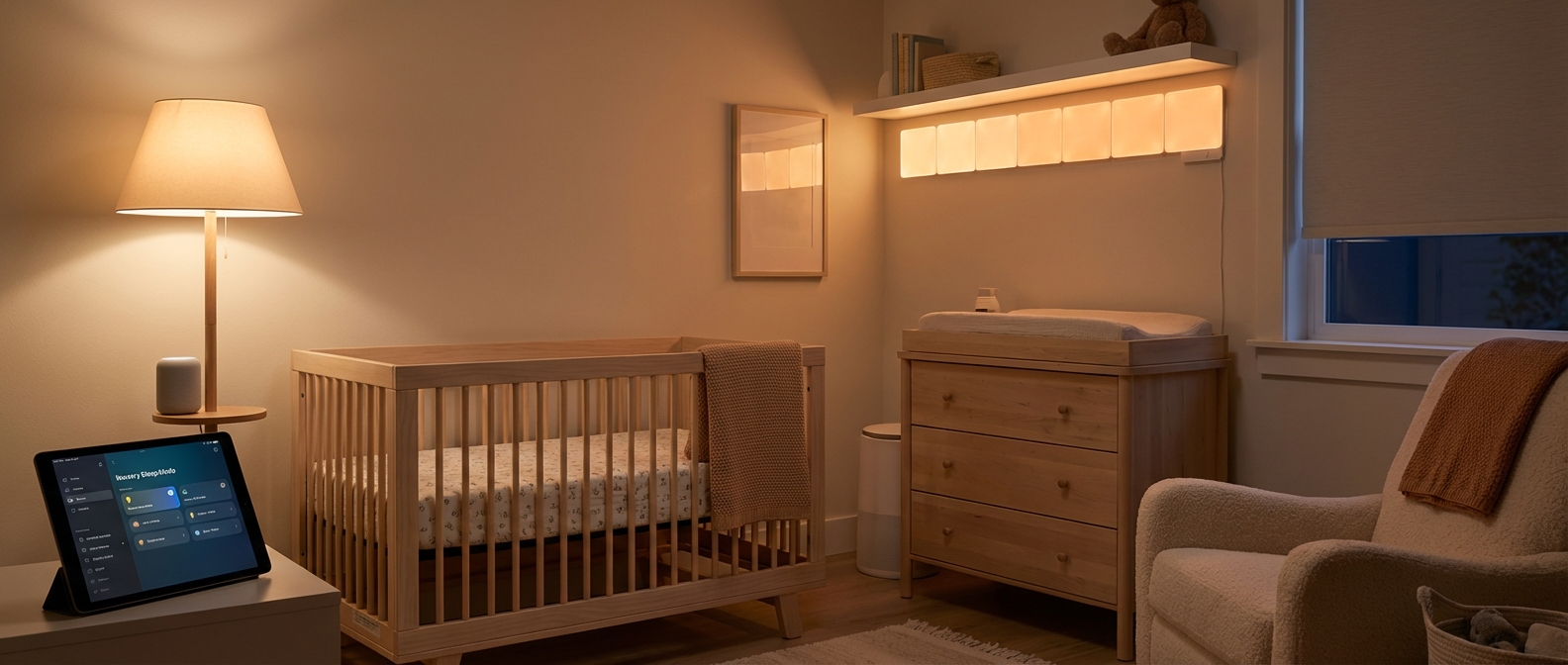
Why Your Nursery Needs Smart Lighting in 2026
Why Your Nursery Needs Smart Lighting in 2026
Smart lighting transforms the nursery into a sleep sanctuary by automating brightness and color temperature to support biological needs. In 2026, features like hands-free control and adaptive circadian algorithms are essential for preserving parental sanity and establishing healthy baby sleep cycles without lifting a finger.
It happens to every new parent. It is 3:00 AM. The baby is screaming. You stumble into the room, sleep-deprived and desperate, and flip the light switch. Flashbang. The harsh glare blinds you, jolts your adrenaline, and—worst of all—signals to your infant that it is time to wake up.
Smart lighting solves this specific nightmare. By 2026, a smart home nursery isn't a luxury; it is a strategic tool for sleep hygiene and survival.
Protecting the Circadian Rhythm
Standard LED bulbs emit high levels of blue light, which suppresses melatonin production. This confuses your baby's developing internal clock. Smart lighting systems automatically adjust color temperatures based on the time of day. Morning light is crisp and energizing; evening light shifts to warm amber or red hues. This transition supports the natural circadian rhythm, helping your baby settle faster after night feeds.
For parents looking to automate these transitions effortlessly, setting up specific schedules is key. You can learn more about optimizing these triggers in our guide to 21 Best Smart Home Routines for Moms in 2026.
The Necessity of Hands-Free Control
When you are balancing a crying infant on one hip and reaching for wipes with the other hand, a physical light switch is useless. Hands-free control is the defining feature of modern nursery lighting.
Whether you use a smart speaker or a motion sensor, the ability to command "Set nursery to night light" without dropping the baby is invaluable. If you haven't chosen a voice ecosystem yet, check out our comparison of Alexa vs. Google Home for Families (2026) to see which assistant handles nursery commands best.
Traditional vs. Smart Nursery Lighting
Here is how the technology stacks up in a direct comparison:
| Feature | Traditional LED Bulb | Smart Nursery Lighting |
|---|---|---|
| Control Method | Physical wall switch only | Voice, App, Motion, & Automation |
| Color Temperature | Fixed (usually harsh white) | Adjustable (Cool White to Deep Red) |
| Dimming Capability | Requires specific hardware dimmer | Built-in digital dimming (1% - 100%) |
| Sleep Impact | Disrupts melatonin (Blue light) | Promotes sleep (Circadian adaptive) |
| Convenience | Requires free hands | Hands-free control |
Beyond the Bulb
Smart lighting also integrates with other devices to create a cohesive safety net. For example, your lights can flash red if a connected smoke detector triggers, or gently pulse when a smart monitor detects movement. For a deeper dive into securing the environment, read our guide on Smart Home Safety for Kids.
Key Features to Look For: A Smart Mom's Checklist
To ensure optimal sleep hygiene and safety in 2026, prioritize fixtures offering tunable white spectrums for circadian support and deep dimmability (below 1%) for non-disruptive night feeds. Essential technical standards include Matter support for cross-platform reliability and a high CRI (90+) to accurately assess skin health during diaper changes.
The Spectrum: Blue Light vs. Red Light
Your baby’s biological clock is incredibly sensitive. In 2026, "smart" isn't just about app control; it is about biological compatibility.
Standard LEDs emit high levels of blue frequencies. During the day, this is fine—it signals "awake" to the brain. However, after sundown, blue light vs red light becomes the critical battleground for sleep. Blue wavelengths aggressively suppress melatonin production.
For the nursery, you need a bulb or fixture capable of a "true red" or deep amber mode (1800K or lower). This specific wavelength allows you to perform 3 AM feedings without triggering your baby’s cortisol receptors, helping them fall back asleep faster. Incorporating this into your schedule is one of the 21 Best Smart Home Routines for Moms in 2026.
True Dimmability & Color Rendering (CRI)
Most cheap smart bulbs fail the "nursery test" because they do not dim low enough.
If a light claims 1% brightness but still illuminates the whole room, it is too bright. You need dimmability that goes down to 0.1% or "moonlight mode." This prevents the "jolt" of sudden light when you voice-activate the lamp in the middle of the night.
Equally important is the Color Rendering Index (CRI).
- Low CRI (<80): Makes skin look washed out or greenish.
- High CRI (90+): Shows true colors.
Why does a high CRI matter for a mom? When checking a sleeping baby for a fever flush, a rash, or jaundice, accurate color representation is a medical necessity, not a luxury.
Connectivity: The Matter Standard
In 2026, proprietary hubs are obsolete. If the packaging does not explicitly state Matter support, put it back on the shelf.
Matter ensures that your nursery lighting works locally, without relying on a cloud server that might go down during a storm. It also guarantees compatibility regardless of whether you are in the middle of the Alexa vs. Google Home for Families debate. You need the light to turn on instantly when you walk in with a crying infant, not three seconds later after the signal bounces off a server.
The 2026 Nursery Lighting Standard
Use this table to vet any device before purchase.
| Feature | Minimum Requirement | Ideal 2026 Standard | Why It Matters |
|---|---|---|---|
| Connectivity | Wi-Fi / Bluetooth | Matter over Thread | Instant response; works if internet is down. |
| Color Spectrum | RGB | RGBWW (Tunable White) | deeply distinct Red/Amber modes for melatonin protection. |
| Brightness | 10% Minimum | <1% (Deep Dimming) | Prevents waking baby fully during feeds. |
| CRI | 80 | 90+ | Accurate skin tone assessment for health checks. |
| Flicker Rate | Standard | Flicker-Free Driver | Prevents subtle eye strain and nervous system agitation. |
Safety Considerations
Beyond the light itself, ensure the physical fixture is secure. Loose cords are a strangulation hazard. As your child grows and becomes mobile, securing these devices becomes paramount. For a deeper dive on securing the physical environment, refer to our guide on Smart Home Safety for Kids: The Ultimate Protection Guide (2026).
The Importance of Red Light & Color Temperature
Red light is the only part of the visible light spectrum that does not suppress melatonin, the hormone critical for regulating sleep-wake cycles. Unlike standard white or blue-hued bulbs, red light allows parents to perform night feeds and diaper changes without signaling to a baby’s brain that it is daytime, ensuring a faster transition back to sleep for both parent and child.
The Science of Sleep and Spectrum
Human eyes contain specialized photosensitive ganglion cells specifically tuned to detect blue wavelengths found in natural sunlight. When these cells detect blue light, they signal the brain to halt melatonin production and increase alertness.
Most standard LED bulbs, even those labeled "soft white," often emit invisible spikes of blue light. In a nursery setting, this is detrimental. Exposure to blue light during a 3:00 AM feeding can reset your infant's circadian rhythm, leading to "split nights" where the baby is awake for hours. Red light possesses a longer wavelength that bypasses these sensors entirely, effectively rendering the light invisible to the body's internal clock.
Understanding the Kelvin Scale
To choose the correct smart bulb, you must understand the Kelvin scale. This measures the color temperature of light. High numbers represent cool, blue daylight, while low numbers represent warm lighting like candlelight.
For a nursery in 2026, a simple dimmer isn't enough. You need tunable white or RGB capabilities.
| Light Type | Kelvin Rating | Impact on Melatonin | Best Nursery Application |
|---|---|---|---|
| Cool Daylight | 5000K - 6500K | High Suppression | Morning wake-ups to establish day/night reversal. |
| Soft White | 2700K - 3000K | Moderate Suppression | Evening reading and winding down before bed. |
| Amber / Candle | 1500K - 2200K | Low Suppression | Pre-sleep routines; bath time. |
| True Red | < 1000K (RGB) | Zero Suppression | Overnight diaper changes and feeding. |
Practical Application for Smart Nurseries
Smart lighting allows you to automate these shifts. You should program your nursery lights to gradually shift from a stimulating 5000K during post-nap play to a melatonin-friendly warm amber by 6:00 PM.
Crucially, ensure your "Night Mode" scene triggers pure red light at 1% brightness. This visibility allows you to check on safety without waking the baby. Establishing these automated lighting transitions is one of the 21 Best Smart Home Routines for Moms in 2026 because it removes the mental load of remembering to dim the lights manually.
- Avoid: Standard nightlights with white or blue plastic covers.
- Prioritize: Smart bulbs with high Color Rendering Index (CRI) and deep red RGB capacity.
- Routine: Set your smart switch to toggle directly to red if pressed between 7:00 PM and 7:00 AM.
Connectivity: Matter, Wi-Fi, and Bluetooth
Connectivity: Matter, Wi-Fi, and Bluetooth
In 2026, Matter is the non-negotiable standard for nursery lighting. Unlike the fragmented ecosystems of the past, Matter ensures your smart nursery devices communicate locally, securely, and instantly with Apple Home, Alexa, and Google Home simultaneously. This local execution eliminates cloud latency, ensuring that when you tap "Night Feed" on your phone at 3:00 AM, the lights respond immediately—even if your internet connection is down.
Why Connectivity Protocol Matters for Sleep
For a nursery, connectivity reliability is paramount. A light that fails to dim because of a Wi-Fi dropout can wake a sleeping infant. While Wi-Fi and Bluetooth remain common in budget devices, Matter-over-Thread offers a self-healing mesh network that becomes stronger as you add more devices, making it the superior choice for modern parents.
Below is a breakdown of how the three major protocols compare for nursery applications:
| Feature | Matter (via Thread) | Wi-Fi | Bluetooth |
|---|---|---|---|
| Reliability | High (Mesh network, self-healing) | Medium (Prone to congestion) | Low (Point-to-point only) |
| Speed | Instant (Local control) | Variable (Cloud dependent) | Slow (Initial pairing lag) |
| Range | Whole Home | Router Dependent | Short (Same room only) |
| Hub Needed? | Requires a Thread Border Router* | No | No |
| Best For | Critical Automation & Sleep Routines | Standalone Lamps | Travel / Temporary setups |
*Note: Most modern smart speakers and streaming sticks now act as Thread Border Routers.
The Matter Advantage
Matter eliminates the need for a proprietary smart home hub specific to one brand (like the old Philips Hue bridges). Instead, it utilizes a "Thread Border Router"—technology likely already built into devices you own, such as an Apple TV 4K, Amazon Echo, or Google Nest Hub. This interoperability allows you to mix and match brands without cluttering your router.
If you are setting up a comprehensive system and need to identify which central device will manage your nursery, review our guide on the Best Smart Home Hubs Compared (2026 Review).
When to Use Wi-Fi or Bluetooth
While Matter is preferred, other protocols serve specific niches:
- Wi-Fi: Ideal for high-bandwidth devices like cameras, but less efficient for simple bulbs. If your nursery has poor Wi-Fi signal, smart bulbs may frequently show as "No Response."
- Bluetooth: Best strictly for travel. If you take a portable sound machine or night light on vacation, direct Bluetooth control is useful because it requires no network setup.
Expert Verdict: Prioritize Matter-compatible lighting to future-proof your nursery. The peace of mind provided by local control and cross-platform compatibility outweighs the minor cost difference in 2026.
Best Smart Lighting for Nursery: Top Picks for 2026
Best Smart Lighting for Nursery: Top Picks for 2026
For 2026, the Hatch Rest+ 2nd Gen remains the definitive best smart nursery light for all-in-one sleep training. Parents prioritizing ecosystem integration and superior dimming should opt for Philips Hue, while Nanoleaf offers the best aesthetic versatility for growing children. We evaluated these devices based on low-light performance, connection stability, and ease of use during 3 AM feeds.
Quick Comparison: Top Nursery Smart Lights
| Product | Best For | Connectivity | Key Feature | Price Tier |
|---|---|---|---|---|
| Hatch Rest+ 2nd Gen | Sleep Training | Wi-Fi / Bluetooth | Time-to-Rise & Battery Backup | $$ |
| Philips Hue Go | Portability & Reliability | Zigbee / Bluetooth | 1% Dimming Capability | $$$ |
| Nanoleaf Elements | Decor & Calm | Wi-Fi / Thread | Circadian Rhythm Lighting | $$$$ |
| Govee Lyra Floor Lamp | Indirect Lighting | Wi-Fi | RGBIC Wall Washing | $$ |
Best Overall for Sleep Training: Hatch Rest+ 2nd Gen
The Hatch Rest+ continues to dominate the nursery sector in 2026 because it solves multiple problems simultaneously. It is not merely a lamp; it is a sound machine, audio monitor, and sleep coach rolled into one matte-finish device.
What sets the Rest+ apart is the "Time-to-Rise" functionality. You can program color changes to signal to your child when it is time to sleep and when it is acceptable to wake up. This feature is a cornerstone among the 17 Best Smart Home Devices for Toddlers in 2026, offering exhausted parents a chance to sleep past 5:00 AM.
- Why it wins: The backup battery. If your power cuts out during a storm, the white noise and night light stay on, preventing a sudden silence that could wake the baby.
- The draw: The audio monitor feature allows you to listen in via your phone without needing a separate radio monitor.
Best for Reliability & Ecosystems: Philips Hue Go
If you already utilize a Hue Bridge, adding a Philips Hue Go to the nursery is the logical choice. While many competitors struggle with low-end dimming—flickering or remaining too bright at 1%—Philips Hue excels.
The Hue Go is a portable, bowl-shaped light that can be detached from its cord and placed anywhere. This is invaluable for late-night diaper changes where you need focused light that doesn't flood the entire room.
- Deep Dimming: Capable of extremely low lumen output to avoid disrupting melatonin production.
- Automation Power: It integrates flawlessly with motion sensors. You can set a routine where the light triggers at a warm, amber 5% brightness if you walk in between 10 PM and 6 AM. For more on setting up these specific automations, consult our guide on 21 Best Smart Home Routines for Moms in 2026.
Best for Decor & Circadian Rhythm: Nanoleaf Elements
Nanoleaf moves beyond the standard bulb form factor. The Elements line features wood-look hexagonal panels that mount to the wall, functioning as art when off and ambient lighting when on.
For a nursery, this provides a softer, diffused glow compared to a direct bulb. Nanoleaf’s "Circadian Lighting" feature automatically adjusts the color temperature throughout the day to mimic the sun—bright white during playtimes to stimulate activity, shifting to warm amber as bedtime approaches.
- Touch Reactive: Toddlers love the tactile interaction; the panels glow gently when touched.
- Future Proof: As your child grows, these panels transition easily from a nursery aid to a cool bedroom feature, justifying the higher price point.
Best for Indirect Lighting: Govee Lyra Floor Lamp
Direct light is often the enemy of infant sleep. The Govee Lyra is a corner floor lamp designed to project light against the wall ("wall washing"), creating a soft, reflected glow that never shines directly into a crib.
Govee offers a robust feature set at a more accessible price point than Hue. The app allows for granular control over segments of the lamp, meaning you can keep the bottom dark (eye level for a crawling baby) while the top emits a soft night light.
- Voice Control: Seamlessly integrates with your voice assistant—check our Alexa vs. Google Home battle to see which platform handles nursery commands with lower latency.
- Safety: The lamp is slim, stable, and uses LEDs that do not generate heat, making it safer around curious hands than traditional incandescent floor lamps.
Best All-in-One: Smart Sound Machine & Night Light Combos
Best All-in-One: Smart Sound Machine & Night Light Combos
The Hatch Rest+ 2nd Gen remains the definitive sound machine combo for modern nurseries in 2026, offering unrivaled customization for sleep training. By consolidating a high-fidelity sound library, a tunable RGB night light, and a two-way audio monitor into a single Wi-Fi-enabled unit, it eliminates the need for multiple gadgets and reduces cord clutter near the crib.
Why the Hatch Rest+ Dominated Our 2026 Testing
Space is a premium in any nursery. We prioritized devices that multitask without sacrificing quality. The Rest+ allows you to control every aspect of the nursery environment from your smartphone, ensuring you never risk waking a sleeping baby by entering the room to adjust the volume.
Key features that set the standard this year:
- Time-to-Rise Programs: This is the core of the device's longevity. You can program specific colors to signal distinct events. A soft amber glow signals bedtime, while a bright green light tells early risers it is acceptable to get out of bed. This visual cue is essential for establishing healthy sleep boundaries.
- The Toddler Lock: Toddlers are notoriously curious. The physical buttons on the device are easily disabled via the app. This toddler lock ensures that curious fingers cannot accidentally crank the white noise to maximum volume or turn off the night light at 3 AM.
- Battery Backup: Unlike standard models, the Rest+ includes an internal battery. If your home loses power during a storm, the sound machine continues running, preserving the sleep environment.
For parents managing older children who are transitioning out of the crib, integrating these specific light cues is a strategy we highlight in our guide to the 17 Best Smart Home Devices for Toddlers in 2026.
Feature Comparison: Hatch vs. The Competition
To help you decide if the premium price point is justified, we compared the Hatch Rest+ against its closest market competitor, the Nanit Sound + Light.
| Feature | Hatch Rest+ (2nd Gen) | Nanit Sound + Light |
|---|---|---|
| Primary Function | Sound Machine, Light, Audio Monitor | Sound Machine, Light |
| Connectivity | Wi-Fi & Bluetooth | Wi-Fi & Bluetooth |
| Power Source | Corded + 8-Hour Battery Backup | Corded Only |
| Control Method | App & Touch Ring | App & Top Buttons |
| Clock Display | Dimmable LED Clock | No Clock |
| Audio Monitor | Yes (2-way talk) | No |
| Price Tier | Premium ($$) | Mid-Range ($) |
Setting Up for Success
The true power of this device lies in automation. Don't just turn it on manually; schedule it.
- Newborn Phase: Set a "Wind Down" routine that triggers automatically at 6:30 PM with red light (which promotes melatonin production) and a heartbeat sound.
- Toddler Phase: Utilize the "Time-to-Rise" feature. Program the light to stay red until 7:00 AM, then switch to green. This visual boundary often buys parents an extra 30 minutes of sleep.
- Remote Management: Use the app to adjust brightness during night feeds. A generic night light requires you to fumble with switches; the Hatch allows you to dim the light to 5% brightness before you even open the nursery door.
While the Hatch ecosystem is robust, ensure your network is stable. A smart nursery device is only as good as the Wi-Fi connecting it.
Best Smart Bulbs for Overhead Lighting
Best Smart Bulbs for Overhead Lighting
For the nursery, the Philips Hue White and Color Ambiance bulb remains the unrivaled gold standard in 2026. Its superior dimming capabilities—dropping below 1% brightness without flickering—make it essential for late-night diaper changes where preserving sleep pressure is paramount. When paired with adaptive lighting features via Apple HomeKit or the native Hue system, these smart bulbs automatically shift from energizing cool white in the morning to melatonin-friendly warm amber at night, actively supporting your baby's developing circadian rhythm.
Comparison: Philips Hue vs. Nanoleaf Essentials
While Philips Hue leads in performance, the Nanoleaf Essentials line offers a compelling alternative for parents utilizing a Thread-based smart home.
| Feature | Philips Hue White & Color Ambiance | Nanoleaf Essentials (Matter) |
|---|---|---|
| Connection Protocol | Zigbee (Hub required for best performance) | Thread / Matter (No Hub) |
| Max Brightness | 1100 - 1600 Lumens | 1100 Lumens |
| Dimming Floor | <1% (Ultra-low, no flicker) | ~3% (Good, slight step-down) |
| Adaptive Lighting | Excellent (Native & HomeKit) | Supported (HomeKit/Matter) |
| Price Point | Premium ($45-$55/bulb) | Budget-Friendly ($15-$20/bulb) |
| Reliability | 10/10 (Rock solid) | 9/10 (Dependent on Border Router) |
The Power of Adaptive Lighting
In a nursery, static lighting is obsolete. A bulb that stays daylight-white at 8:00 PM signals the infant brain to stay awake. Adaptive lighting technology solves this by synchronizing the color temperature of your overhead lights with the position of the sun.
In 2026, this happens locally on the device. You do not need to manually adjust settings every evening. Once installed, the bulb emits a crisp, blue-enriched light during playtimes to stimulate alertness. As the evening approaches, it imperceptibly shifts to a warm, orange hue. This removes the blue light spectrum that suppresses melatonin production, helping your baby settle faster.
For parents building out comprehensive automation, integrating these lights into sleep schedules is vital. You can find specific examples of how to schedule these shifts in our guide to the 21 Best Smart Home Routines for Moms in 2026.
Why You Need High Lumen Output
While dimming is crucial for sleep, maximum brightness is equally important for hygiene and safety. You need high lumen output (at least 1100 lumens) for the "messy moments."
When a blowout happens at 2:00 PM, soft ambient light is insufficient. You need clear visibility to ensure the changing table and surrounding area are sanitized effectively. Both Philips Hue and Nanoleaf offer distinct "Concentrate" or "Daylight" modes that instantly flood the room with bright, clinical light, ensuring you don't miss a spot before reverting to a softer setting.
Our Recommendation
- Choose Philips Hue if: You want the absolute lowest dimming levels for night feeds and already use a Hue Bridge. The ecosystem reliability is unmatched.
- Choose Nanoleaf Essentials if: You are building a modern Matter-over-Thread smart home and want a cost-effective solution that still supports circadian lighting features.
Best Decorative & Portable Smart Lamps
Best Decorative & Portable Smart Lamps
For parents seeking flexibility, the Philips Hue Go stands as the premier choice in 2026 due to its seamless integration with major ecosystems and superior color rendering. However, for durability and HomeKit users, the Eve Flare is unmatched. A reliable portable nursery light must offer at least 6 hours of battery life, cool-to-touch LEDs, and a grab-and-go form factor to transition effortlessly from the changing table to the feeding chair.
Why Go Cordless?
Fixed lighting limits your mobility. A cordless smart lamp allows you to bring a soft, warm glow directly to the task at hand without illuminating the entire room. Whether you are searching for a pacifier under the crib or need focused light for a diaper change, these devices function as a lantern for the modern parent.
When selecting a lamp that might eventually end up in a toddler's hands, safety is paramount. Ensure the device uses robust materials and remains cool during operation. For a broader look at child-proofing your tech, review our guide on Smart Home Safety for Kids: The Ultimate Protection Guide (2026).
Top Picks for 2026
1. Philips Hue Go (Portable Table Lamp) The Hue Go remains the market leader for a reason. It supports Bluetooth and the Matter standard, meaning it plays nicely with almost any setup.
- Performance: Delivers up to 48 hours of light on the "Cozy Candle" setting, though bright functional light lasts closer to 4 hours.
- The "Mom" Benefit: The on-device button allows you to cycle through preset scenes without fumbling for your phone at 2 AM.
- Durability: Solid, but the casing can scratch if dropped on hardwood.
2. Eve Flare If your household runs on Apple Home, the Eve Flare is essential. Its spherical design features a carry handle, making it easy to hook onto a rocking chair or carry during midnight travels.
- Ruggedness: It has an IP65 water resistance rating. Spilled milk or a toddler throwing it into the diaper pail won't destroy it.
- Charging: Uses a wireless charging base, eliminating fiddly cables.
3. Govee Portable Table Lamp For those who want Wi-Fi connectivity without the premium price tag, Govee delivers.
- Features: It syncs with both Alexa and Google Assistant effortlessly. If you are undecided on which voice assistant suits your family, check our comparison: Alexa vs. Google Home for Families (2026).
- Versatility: Offers dynamic scene modes that can mimic a gentle campfire or ocean waves to act as a visual sound machine.
Technical Comparison
| Feature | Philips Hue Go | Eve Flare | Govee Portable |
|---|---|---|---|
| Battery Life (Low) | Up to 48 Hours | Up to 6 Hours | Up to 4 Hours |
| Connectivity | Zigbee / Bluetooth | Thread / Bluetooth | Wi-Fi / Bluetooth |
| Durability | Moderate (Indoor) | High (IP65 Rated) | Moderate |
| Control | App, Voice, On-Device | App, Voice (Siri) | App, Voice, Touch |
| Best For | Ecosystem Integration | Durability & Safety | Budget & Visual Effects |
Automation Tip
Don't just use these as manual lights. Set a "Wake Up" routine where your portable lamp gradually brightens from 0% to 30% warm white starting 15 minutes before feed time. This signals your brain—and the baby's—that it is time to wake up gently, reducing sleep inertia. You can find more automation ideas in our article on 21 Best Smart Home Routines for Moms in 2026.
Best Smart Light Strips for Under-Crib Glow
Best Smart Light Strips for Under-Crib Glow
Under crib lighting transforms a standard nursery into a sleep sanctuary by projecting light onto the floor rather than the baby’s face. This technique, known as indirect lighting, allows parents to perform diaper changes and safety checks without triggering the infant’s wake response. For 2026, the Govee M1 stands out as the superior choice due to its high LED density and Matter compatibility, offering a seamless, fluid glow that eliminates harsh "light dots" common in cheaper models.
Why Indirect Glow Matters
Direct overhead lighting suppresses melatonin production. By adhering a smart light strip to the underside of a crib or changing table, you create a diffuse wash of light across the floor. This provides just enough visibility to navigate the room and find a pacifier, yet remains dark enough at eye level to keep the baby drowsy.
When installing these devices, cable management is non-negotiable. Loose wires at floor level pose a significant risk once your infant becomes mobile. For detailed protocols on securing devices in the nursery, refer to our guide on Smart Home Safety for Kids: The Ultimate Protection Guide (2026).
Top Smart Light Strips for Nurseries (2026)
| Product | Best For | Connectivity | Cuttable? | Key Feature |
|---|---|---|---|---|
| Govee M1 (Matter) | Overall Best | Wi-Fi + Matter | Yes | RGBIC+ technology for the smoothest, dot-free gradient. |
| Philips Hue Gradient | Ecosystem Integration | Zigbee (Hub req.) | Yes (at marks) | Unmatched reliability and HomeKit Adaptive Lighting support. |
| Nanoleaf Essentials | Budget / Thread | Thread / Bluetooth | Yes | Direct Thread connection requires no hub; excellent Circadian Lighting. |
| LIFX Lightstrip | Brightness | Wi-Fi | Yes | Polychrome technology allows multiple colors per strip without a hub. |
The Govee M1 Advantage
While Philips Hue remains a premium staple, the Govee M1 has captured the 2026 market for nursery setups. Its specific advantage lies in density: 60 LEDs per meter.
- Fluidity: Under a crib, reflection matters. Lower density strips create a "spotted" reflection on hardwood floors. The M1 creates a solid bar of light.
- Matter Support: As of 2026, the M1 integrates seamlessly with Apple Home, Google Home, and Alexa without requiring a proprietary bridge.
- White Balance: The M1 produces warm whites (2200K) that are free of the blue-light spectrum spikes found in budget RGB strips.
Installation Tips for Maximum Safety
- Surface Prep: Clean the underside of the crib frame with isopropyl alcohol to ensure the adhesive cures properly.
- Cornering: Do not fold the strip at a sharp 90-degree angle, as this damages the circuitry. Create a small loop at corners.
- Controller Placement: Mount the physical controller box high on the back leg of the crib or changing table, well out of reach of a crawling infant.
- Automation: Set the strip to turn on at 1% brightness in Red or Warm Amber when motion is detected at floor level between 10:00 PM and 6:00 AM.
Setting the Scene: Essential Nursery Automations
Setting the Scene: Essential Nursery Automations
Smart nursery lighting automations allow you to program lights to adjust color, temperature, and brightness automatically based on your baby's sleep schedule. By utilizing Apple HomeKit scenes or Alexa routines, you create a hands-free environment that mimics natural circadian rhythms—transitioning from bright, alert light during play to deep, melatonin-friendly red hues for sleep—without ever touching a switch.
Hardware is only half the battle. The real magic happens when you program that hardware to anticipate your needs. Below are the three essential automation "recipes" every parent needs in 2026 to maximize sleep hygiene.
1. The "Ghost Mode" Night Feeding Routine
Fumbling for a switch at 3:00 AM wakes your brain up. This routine ensures you have just enough light to nurse or feed without disrupting the baby’s sleep cycle (or yours).
** The Goal:** Trigger a deep red light at 10% brightness instantly. Red light has the lowest impact on melatonin production.
How to Program It:
- Trigger: A specific voice command (e.g., "Alexa, baby is hungry") or a smart button placed on the nursing chair.
- Action: Set the nursery smart bulb to "Red" and Brightness to "10%".
- Auto-Off: Set a "Wait" command for 20 minutes, then "Turn Off."
This specific setup is often cited as one of the 21 Best Smart Home Routines for Moms in 2026 because it prevents the accidental activation of overhead "daylight" bulbs during the night.
2. The "Sunset Fade" Wind-Down
Sudden darkness can startle an infant. A gradual fade mimics the setting sun, signaling to the infant’s brain that sleep is approaching.
The Goal: Automatically transition lighting from warm white to dim amber over 30 minutes before bedtime.
How to Program It:
- Trigger: Time of Day (e.g., 6:30 PM).
- Action:
- Set light to "Warm White" at 50%.
- Ramp brightness down to 10% over a 30-minute duration.
- Change color to "Amber" or "Orange" at the 15-minute mark.
Pro Tip: If you are using Apple HomeKit scenes, utilize the "Adaptive Lighting" feature, which handles color temperature shifts automatically throughout the day.
3. Advanced Integration: The "Crying Monitor" Trigger
For parents wanting a highly responsive nursery, you can link sound detection to lighting. This requires a bridge between platforms, often utilizing IFTTT (If This Then That) if your ecosystem is fragmented.
The Goal: Gently illuminate the room only if the baby cries for more than 10 seconds, allowing you to check the camera feed without turning on a light manually.
How to Program It:
- Trigger: Smart Monitor detects sound > 60dB.
- Condition: Time is between 10:00 PM and 6:00 AM (Critical step to avoid daytime triggers).
- Action: Turn smart base light to "Soft White" at 5%.
Platform Capability Comparison
Not all ecosystems handle nursery automation equally. Use this table to decide which logic engine fits your technical comfort level.
| Ecosystem | Best Feature for Nursery | Complexity | Automation Strength |
|---|---|---|---|
| Amazon Alexa | Alexa routines allow for sound detection triggers (baby crying) natively on Echo devices. | Low | High (Great for voice triggers) |
| Apple HomeKit | Apple HomeKit scenes offer "Adaptive Lighting" for superior circadian rhythm management. | Medium | High (Best for privacy & speed) |
| Google Home | Deep integration with Nest Cams for motion-based lighting triggers. | Low | Medium |
| IFTTT | Connects disparate brands (e.g., Owlet monitor triggers LIFX bulbs). | High | Very High (Unlimited customization) |
While setting these up, ensure your network is robust. A disconnected light at 2 AM is a major frustration. For a deeper dive on stabilizing your infrastructure, refer to our Smart Home Setup Guide for Moms.
The 'Night Feed' Scene
The "Night Feed" Scene
A "Night Feed" scene is a specialized smart home automation that instantly adjusts lighting and audio to support infant care without disrupting the circadian rhythms of the parent or baby. By utilizing preset scenes, you ensure that a single trigger creates the optimal environment for sleep maintenance, preventing the dreaded "wide awake" state caused by harsh overhead lighting.
The science here is straightforward. Exposure to blue-spectrum light (common in standard bulbs) suppresses melatonin. To keep everyone drowsy during a 3 AM feed, you must eliminate blue wavelengths and rely on low-intensity red light.
The Perfect Configuration
To execute this effectively, you need to bundle three specific actions into one automation. This prevents you from fumbling with multiple apps while holding a crying infant.
The "Night Feed" Protocol:
| Component | Action | Setting | Why It Works |
|---|---|---|---|
| Smart Lighting | Turn On | 10% Brightness | Provides just enough visibility to latch or mix a bottle without dilation shock. |
| Color Spectrum | Change Color | Deep Red (approx. 1000K) | Red light has the least impact on melatonin production, keeping the brain in "sleep mode." |
| Audio Assistant | Play Media | White Noise (Loop) | Masks household creaks and creates a consistent auditory sleep association. |
Step-by-Step Execution
Hands-free control is the priority here. When your arms are occupied with a swaddled baby, a crisp voice command is your only viable interface. Whether you are using Alexa or Google Home, the setup logic remains consistent for 2026 smart ecosystems.
- The Trigger: Set your phrase. Keep it short. "Activate Night Feed" or simply "Baby Time."
- The Lighting Transition: Program your smart bulbs (like Philips Hue or Nanoleaf) to fade in over 3 seconds rather than snapping on instantly. This softens the transition for your eyes.
- The Audio Overlay: Ensure the white noise volume is set to a low background level (around 50dB) so it soothes rather than startles.
- The Exit Strategy: Crucially, program a follow-up command or a "Sleep" scene that turns everything off or reverts the white noise to its standard overnight volume once the feed is done.
This automation is often cited as a sanity saver. For more ways to automate your day, review our guide on 21 Best Smart Home Routines for Moms in 2026.
Pro Tip: If you are bottle-feeding, integrate a smart plug into this scene to begin warming the bottle warmer immediately. You can read more about compatible devices in our review of the 5 Best Connected Baby Bottle Warmers in 2026.
The 'Good Morning' Wake Up
The Science of the Gradual Rise
Sunrise simulation is the practice of programming smart lights to gradually increase in brightness and shift color temperature over a set duration, mimicking the natural dawn. By slowly transitioning from deep amber to soft white, you suppress melatonin production and stimulate cortisol, effectively resetting your baby's circadian rhythm. This process ensures a gentle wake up, preventing the "sleep inertia" and crankiness often caused by sudden exposure to harsh overhead lighting or loud alarms.
Why Automation Beats the Switch
Relying on manual switching invites human error. In 2026, the most effective nurseries integrate lighting directly into automated schedules. You set the "sunrise" to begin 30 minutes before the desired wake time. If your goal is a 7:00 AM start, the light begins its fade-in at 6:30 AM at 1% brightness. By the time you enter the room, the environment is fully lit, and the baby is naturally alert.
For parents juggling multiple schedules, integrating this into broader automation is key. You can find detailed setups in our guide on 21 best smart home routines for moms in 2026.
Key Features for Morning Routines
Not all smart bulbs handle the morning transition equally well. When selecting lighting for a gentle wake up, prioritize these specifications:
| Feature | Why It Matters | Ideal Setting |
|---|---|---|
| Deep Dimming | Standard LEDs often flicker below 10%. You need a bulb that holds a steady glow at 1% to start the sequence without startling the baby. | 0.1% to 100% range |
| Tunable White | A fixed cool white bulb is too harsh for the start of the cycle. The light must shift from warm (red/orange) to cool (blue/white). | 2200K (Start) $\rightarrow$ 4000K (End) |
| Fade Duration | Short transitions don't allow the biological clock to adjust. A longer fade mimics the actual sun. | 20–30 Minutes |
| Audio Sync | Pairing light with sound reinforces the "wake" signal. | Soft birdsong or nature sounds |
Execution Tips for Success
- Start Dark: Ensure blackout curtains are effective. The simulation only works if the smart light is the primary source of illumination.
- Positioning: Place the light source indirectly. Never point a smart bulb directly at the crib. Bounce the light off a wall or ceiling to diffuse the increasing brightness.
- Consistency: Keep the wake-up time consistent, even on weekends. This helps solidify the infant's sleep-wake cycle faster.
Mastering the morning light is just one part of the equation. As your child grows and gains mobility, you will need to adjust how these devices interact with their environment. For advice on toddler-proofing your automated nursery, review our insights on 17 best smart home devices for toddlers in 2026.
Safety Considerations for Smart Nursery Gear
Safety Considerations for Smart Nursery Gear
Smart lighting is overwhelmingly safe for nurseries when properly installed, with the primary risks stemming from physical installation rather than the technology itself. Modern LEDs eliminate burn hazards by running cool, and current research indicates standard Wi-Fi frequencies pose no significant health risk to infants. Parents should prioritize secure mounting and rigorous cord management over radiation concerns.
The Physical Hazards: Cords and Placement
The most critical danger in a nursery is not digital; it is the strangulation risk posed by loose power cables. Smart lamps often require constant power, meaning cords are always present.
- Distance Rule: Keep all lamps and cords at least three feet (one meter) away from the crib, bassinet, or changing table.
- Cord Concealment: Use rigid plastic cord covers (raceways) adhered to the wall. Do not rely on staples or simple tape, which toddlers can pry loose.
- Device Stability: Ensure tabletop smart lamps are weighted or adhered to the surface to prevent them from being pulled down onto a child.
For a comprehensive checklist on securing all your connected devices, read our guide on Smart Home Safety for Kids: The Ultimate Protection Guide (2026).
Heat Emission and Burn Prevention
Traditional incandescent bulbs convert roughly 90% of their energy into heat, creating a genuine burn hazard if a child touches the fixture or if a blanket is tossed over it. Smart lighting utilizes Light Emitting Diodes (LEDs), which fundamentally changes the safety profile.
LED heat emission is negligible. Even after operating at 100% brightness for hours, a smart bulb remains cool or merely warm to the touch. This efficiency drastically reduces fire risks and ensures that accidental contact will not result in injury.
Addressing Wi-Fi and EMF Concerns
Many parents worry about the invisible "smog" of radio frequencies (RF) and electromagnetic fields (EMF) around a developing infant. It is vital to distinguish between ionizing radiation (like X-rays) and non-ionizing radiation (like Wi-Fi and Bluetooth).
Smart bulbs emit very weak signals, significantly lower than those from your smartphone or a standard video baby monitor. Current scientific consensus supports the safety of these devices in residential settings. However, to alleviate parental anxiety and maximize baby safety, consider these best practices:
- Hub-Based Lighting: Opt for systems (like Philips Hue or Lutron) that use a hub. The bulbs communicate via Zigbee or Lutron Clear Connect, which use lower power frequencies than direct Wi-Fi bulbs.
- Router Placement: Keep the main high-power Wi-Fi router outside the nursery.
- Scheduled Downtime: Use your router's app to schedule Wi-Fi off-time during deep sleep hours if it offers peace of mind.
Comparison: Smart LED vs. Traditional Nursery Lighting
| Feature | Smart LED Fixture | Traditional Incandescent Lamp |
|---|---|---|
| Heat Surface Temp | < 100°F (Safe to touch) | > 200°F (Burn hazard) |
| Glass Danger | Often plastic or shatter-resistant | Fragile glass (Cut hazard) |
| Control | Remote/Voice (No fumbling in dark) | Manual switch (Trip hazard) |
| EMF Output | Low (Non-ionizing RF) | Low to None |
| Fire Risk | Extremely Low | Moderate (if covered) |
Frequently Asked Questions
Frequently Asked Questions
Is smart lighting safe for babies?
Is smart lighting safe for babies? Generally, yes. The technology itself poses no radiation risk, but physical installation requires care. The main safety advantage is the ability to filter out blue light, which protects developing circadian rhythms. However, you must secure all loose cords and ensure bulbs are shatterproof or enclosed to prevent accidents.
For a deeper dive into securing your nursery environment, consult our guide on Smart Home Safety for Kids: The Ultimate Protection Guide (2026).
To ensure total safety, prioritize these three factors:
- Photo-biological Safety: Choose bulbs rated RG0 (risk-free) to avoid retinal damage from excessive blue light intensity.
- Electrical Security: Use smart plugs or bulbs that do not require exposed adapters near the crib.
- Heat Emission: LEDs run significantly cooler than incandescent bulbs, reducing burn risks if a toddler touches a lamp.
Why is red light better for newborns than white light?
Red light for newborns is scientifically proven to be the least disruptive part of the visible spectrum for sleep. Unlike blue or bright white light, which suppresses melatonin (the sleep hormone), red light has a long wavelength that mimics the low-light environment of the womb, allowing for night feeds without fully waking the infant.
Understanding how different light spectrums affect infant sleep is crucial for establishing a healthy routine in 2026.
| Light Color | Wavelength | Effect on Sleep | Best Use Case |
|---|---|---|---|
| Red | ~620-750 nm | Neutral/Positive. Does not suppress melatonin. | Night feedings, diaper changes, overnight glow. |
| Amber/Orange | ~590-620 nm | Minimal Impact. Low blue-light emission. | Evening wind-down routines, reading bedtime stories. |
| Cool White | ~450-495 nm | Negative. Suppresses melatonin; increases alertness. | Daytime play, cleaning, medical checks. |
| Blue | ~450-495 nm | Highly Disruptive. Halts melatonin production immediately. | Avoid completely after sunset. |
Do I need a hub for nursery smart lights?
Do I need a hub to operate smart nursery lighting? Not necessarily, as many 2026 models operate directly via Wi-Fi or Bluetooth. However, a dedicated hub (or a Thread border router) is highly recommended for nurseries to ensure 100% reliability, faster response times, and to prevent internet outages from disabling your lighting controls during a 3 AM crisis.
Here is why many parents eventually upgrade to a hub-based system:
- Reliability: Hubs like the Hue Bridge create a local network (Zigbee), meaning your lights work instantly even if the Wi-Fi drops.
- Scalability: If you plan to add motion sensors or smart switches later, a hub manages traffic better than a standard router.
- Automation: Complex routines, such as "fade in over 30 minutes," often run smoother on hub-based systems.
For a detailed breakdown of the current market leaders, read The Smart Mom’s Guide: Best Smart Home Hubs Compared (2026 Review).
Can smart lights replace a traditional sound machine?
Many hybrid devices now combine sound and light, but dedicated smart lights focus strictly on illumination. A hybrid device offers convenience and saves outlet space, which is vital in smaller nurseries. However, standalone smart bulbs often offer higher lumens and better color saturation than the integrated lights found in sound machines.
If you are looking for all-in-one devices that manage both noise and light for older children, check our recommendations in 17 Best Smart Home Devices for Toddlers in 2026 (Safety & Sleep Guide).
Pros of Separation:
- Redundancy: If the light breaks, you still have white noise.
- Placement: You can place the sound machine near the crib and the light near the changing table.
Pros of Integration:
- Simplicity: One app controls the entire sleep environment.
- Cost: Usually cheaper than buying two premium smart devices.