
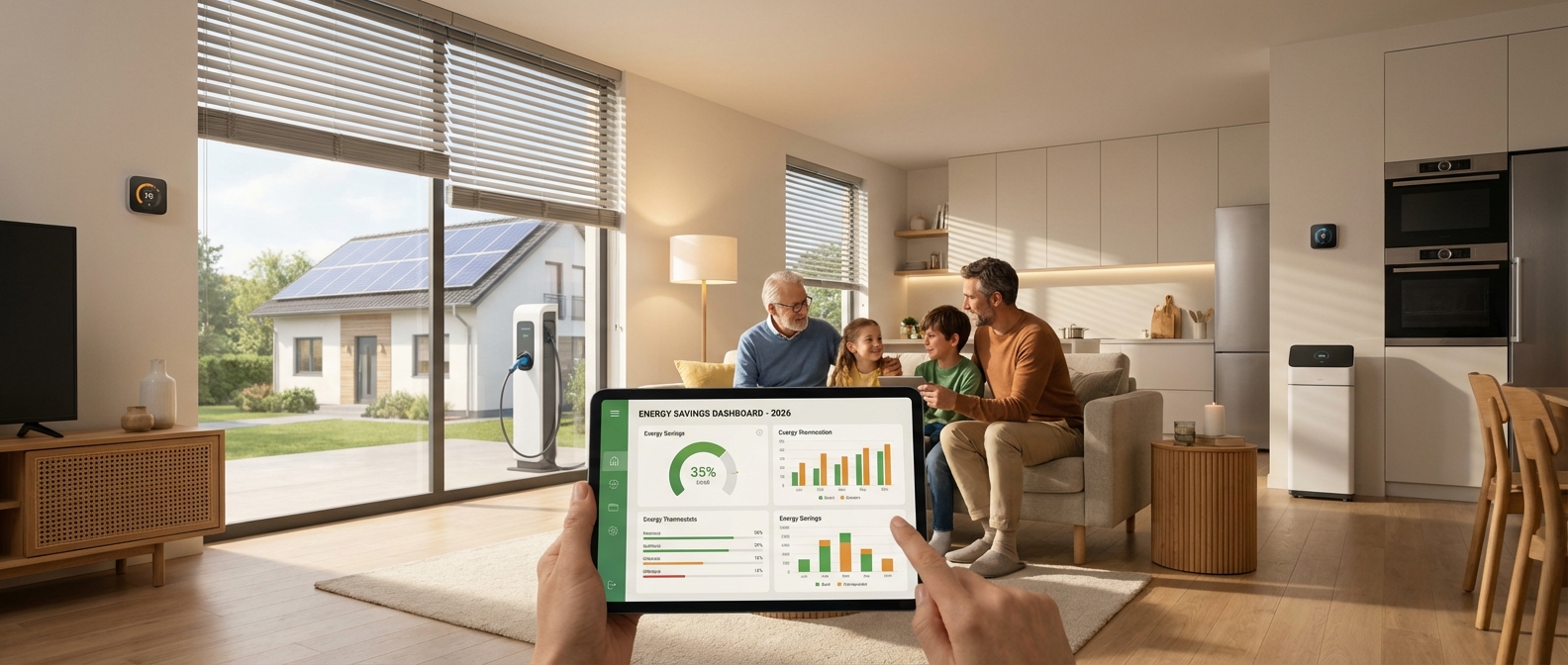
Why 2026 is the Year to Automate Your Energy Savings
Why 2026 is the Year to Automate Your Energy Savings
Rising utility costs in 2026 have made energy automation a non-negotiable strategy for household financial health. Modern smart ecosystems now offer "set-it-and-forget-it" efficiency, slashing monthly bills by proactively managing consumption during peak hours. This shift turns your home into an active partner in protecting the family budget rather than a passive drain on resources.
The era of cheap energy is behind us. With national grids under pressure and rates climbing, waiting for the monthly bill to arrive before taking action is a losing battle. Rising utility costs 2026 trends indicate that families who fail to modernize their energy consumption could see a 15-20% increase in overhead compared to just two years ago.
However, the narrative around smart technology has changed. It is no longer a playground for tech enthusiasts; it is a critical tool for the modern, budget-conscious mom. The goal isn't to fill your house with gadgets, but to deploy an invisible system that works for you. Your home should automatically lower the blinds when the sun hits the living room and cut power to the game console when it’s not in use.
Implementing these systems delivers immediate smart home ROI. The technology has matured to the point where the hardware often pays for itself within the first winter season.
The Efficiency Gap: Manual vs. Automated Savings
| Energy Sector | The "Old Way" (Manual) | The 2026 Smart Way (Automated) | Estimated Annual Saving |
|---|---|---|---|
| Heating & Cooling | Adjusting dial when you feel hot/cold. | AI learns patterns; geofencing cuts heat when you leave. | $180 - $240 |
| Lighting | Relying on kids to flip switches. | Occupancy sensors and "All Off" voice commands. | $60 - $90 |
| Phantom Power | Devices draw power 24/7 in standby. | Smart plugs kill power to entertainment centers at night. | $50 - $100 |
| Peak Usage | Running dryer during expensive hours. | Appliances auto-schedule for cheapest rate windows. | $70 - $120 |
Prioritizing these upgrades is one of the most effective family budget tips for the coming year. It removes the mental load of constantly nagging family members to turn off lights. Instead, the house self-regulates.
While saving money is crucial, these systems also free up mental bandwidth. A home that manages its own energy consumption allows you to focus on running the household rather than monitoring the meter. For a deeper dive into how technology can further streamline your daily routine, read our guide on essential connected devices for perfect family organization.
By treating energy automation as an infrastructure investment rather than a tech purchase, you insulate your finances against volatility. 2026 is the year to stop renting your energy comfort and start managing it with precision.
The Heavy Lifters: Smart Climate Control
The Heavy Lifters: Smart Climate Control
Heating and cooling represent the single largest energy drain in modern households, often accounting for nearly 50% of utility costs. To effectively slash bills in 2026, families must move beyond basic scheduling and embrace AI-driven climate control that utilizes predictive algorithms and granular zoning to eliminate waste without sacrificing comfort.
AI-Driven Habits and Geofencing
The "smart" thermostats of the early 2020s required manual programming. Today, smart thermostat savings are driven by autonomy. In 2026, leading HVAC controllers utilize advanced machine learning to understand the thermal properties of your home. They know exactly how long it takes to heat your living room from 68°F to 72°F when it is 30°F outside.
More importantly, they understand your family's chaotic schedule. Through multi-user geofencing energy saving protocols, the system tracks the location of authorized smartphones.
- The School Run Scenario: The system recognizes a recurring pattern: Mom leaves at 2:45 PM for school pickup.
- The Adjustment: Instead of maintaining a set temperature, the HVAC drifts into "Eco Mode" the moment she crosses the geofence perimeter.
- The Return: The system anticipates the 3:15 PM return, engaging the heat 10 minutes prior so the house is comfortable exactly when the door opens.
This eliminates the "set it and forget it" waste of heating an empty house during erratic errands. While HVAC automation handles the heavy lifting of energy reduction, other gadgets help streamline daily logistics. For a broader look at household efficiency, review our guide on connected devices for family organization.
Granular Control: Zone Heating
The era of heating the entire house to keep one occupied room warm is over. Zone heating for families is the most effective way to target energy usage. By utilizing smart vents or room-specific sensors, you direct airflow strictly where it is needed.
In a two-story home, heat naturally rises. Smart zoning detects that the upstairs bedrooms are 74°F while the downstairs family room is 68°F. Intelligent vents will restrict airflow upstairs and channel the furnace's output downstairs, balancing the home faster and reducing furnace runtime.
2026 HVAC Technology Comparison
To understand the financial impact, compare the capabilities of a standard programmable unit versus the AI-driven systems available this year.
| Feature | Standard Programmable Thermostat | AI-Driven Smart System (2026) |
|---|---|---|
| Operation Logic | Rigid time-based schedule (e.g., Heat on at 5 PM). | Predictive Presence: Heats based on real-time location and learned habits. |
| Occupancy Detection | None or single motion sensor on the unit. | Room-by-Room Sensors: Prioritizes occupied rooms; ignores empty guest rooms. |
| Weather Adaptation | None. | Local Weather Integration: Adjusts radiant heating based on forecasted solar gain. |
| Maintenance | Manual filter checks. | HVAC Health Monitoring: Alerts you to efficiency drops before the unit fails. |
| Est. Annual Savings | 10-12% | 23-30% |
By allowing the system to make micro-adjustments based on real-time data, you stop paying to heat the air in empty hallways and start paying only for the comfort your family actually experiences.
AI Thermostats: Beyond Basic Scheduling
AI Thermostats: Beyond Basic Scheduling
Smart home energy saving for families in 2026 has shifted entirely from reactive scheduling to proactive, predictive intelligence. Instead of simply following a timer, modern AI thermostats analyze hyper-local weather forecasts to adjust your home's climate hours before a temperature swing occurs. This predictive capability ensures your HVAC system uses the least amount of energy possible to maintain comfort, effectively eliminating the high-cost "catch-up" cycles required by older devices.
Predictive Weather Adjustments
Traditional smart thermostats wait for the indoor temperature to drop before activating the furnace. 2026-era AI models anticipate the drop. If a cold front is forecasted to hit your neighborhood at 4:00 PM, the system will slightly increase the temperature at 2:00 PM.
This leverages thermal inertia. By pre-heating the home while the sun is out or outdoor temperatures are milder, the system prevents the heater from working overtime during the evening freeze. This is particularly effective for families with complex schedules; the house manages itself. For more hardware that streamlines household management, consider reviewing our guide on essential connected devices for family organization.
Mastering Peak Pricing with 'Eco Mode'
The most significant bill-slashing feature this year is the integration of real-time utility pricing with 'Eco Mode'. Energy providers now utilize aggressive Time-of-Use (TOU) rates. Your thermostat acts as a financial broker for your energy usage:
- Pre-Cooling/Pre-Heating: The system identifies an upcoming price spike (e.g., 5:00 PM to 8:00 PM). It conditions the home to a comfortable level using cheap mid-day electricity.
- Coast Mode: During the expensive window, the system engages 'Eco Mode,' minimizing HVAC usage and letting the home "coast" on the pre-stored thermal energy.
- Grid Synchronization: It communicates directly with the smart grid to avoid usage during "demand response" events, often earning bill credits in the process.
Comparison: Standard Smart Thermostats vs. 2026 AI Models
| Feature | Standard Smart Thermostat (2020-2024) | AI Predictive Thermostat (2026) |
|---|---|---|
| Trigger Mechanism | Reacts to current indoor temperature. | Acts on future weather data & thermal inertia. |
| Pricing Awareness | Static scheduling (manual set). | Real-time sync with utility TOU rates. |
| Energy Strategy | On/Off cycling to hold setpoint. | Variable speed "trickle" heating/cooling. |
| Efficiency Gain | ~10-15% savings. | 22-30% savings via load shifting. |
By utilizing variable-speed compressors and furnaces, these systems run at lower, more efficient capacities for longer durations rather than blasting at 100% power. This approach not only reduces the monthly bill but significantly extends the lifespan of your HVAC hardware.
Smart Blinds: The Passive Energy Saver
Smart blinds are the unsung heroes of smart home energy saving for families, functioning as dynamic insulation for your windows. By automatically closing during peak summer sun to block heat and opening to harvest solar warmth in winter, they significantly reduce the workload on your HVAC system. This passive regulation slashes heating and cooling costs without requiring a single manual adjustment.
Manual window treatments fail because they rely on human memory. Busy parents rarely have time to adjust shades five times a day to track the sun. Automated shading removes this friction entirely. Once integrated into your ecosystem, these devices sync with local weather data or light sensors to optimize your home’s thermal envelope. It is a "set it and forget it" luxury that actively pays for itself.
Seasonal Energy Impact of Smart Blinds
| Season | Automated Action | Energy Benefit |
|---|---|---|
| Summer | Blinds close during peak sunlight hours. | Reduces solar heat gain by up to 45%, lowering AC demand. |
| Winter (Day) | Blinds open to face the sun. | Harvests free solar heat, reducing furnace runtime. |
| Winter (Night) | Blinds close at sunset. | Adds an extra layer of insulation to prevent heat loss through glass. |
To maximize ROI in 2026, prioritize these capabilities:
- Solar-Powered Motors: Eliminate the need for battery changes or expensive hardwiring.
- Thermostat Integration: Ensure the blinds communicate with your smart thermostat to close automatically if a specific room temperature is exceeded.
- Retrofit Controllers: Devices that attach to your current wands or cords allow you to automate existing window treatments at a fraction of the cost of full replacement.
Integrating automated shading is a critical step toward a self-regulating household. For a broader look at automation tools that streamline daily life, explore our guide on essential connected devices for family organization in 2026.
Killing Vampire Power: Smart Plugs & Monitoring
Killing Vampire Power: Smart Plugs & Monitoring
Vampire power is the electricity wasted by appliances that remain active while technically "off," accounting for nearly 10% of a modern household's utility bill. The most effective method to eliminate this waste involves deploying smart plugs with energy monitoring, which automatically sever the electrical connection to high-drain electronics like gaming consoles and entertainment hubs, ensuring zero consumption when devices are not in use.
The "Always-On" Family Home
In 2026, the average family home is a minefield of vampire power devices. It goes by many names—phantom load, idling current—but the financial impact is tangible. While a single phone charger draws negligible current, the cumulative effect of a fully equipped smart home is significant.
Consider the typical living room setup. Your teenager’s gaming console sitting in "instant-on" mode to download updates draws significant wattage. The soundbar, the OLED TV, the mesh router node, and the coffee maker with a digital clock all contribute to standby power consumption. These devices sip electricity 24/7, keeping transformers warm and Wi-Fi radios listening for commands they rarely receive.
Smart Plugs: The First Line of Defense
You do not need a complex electrical retrofit to stop this bleeding. Smart plugs represent the cheapest, most effective entry point for immediate energy reduction. However, not all plugs are equal. You must prioritize smart plugs with energy monitoring.
These devices offer a dual advantage:
- Visualization: They reveal the exact cost of running specific appliances, often exposing older devices (like a garage fridge or plasma TV) as energy hogs.
- Automation: They physically cut power based on schedules or presence detection, reducing phantom load to zero.
Typical Standby Culprits & Savings Potential (2026 Estimates)
| Device Category | Typical Standby Wattage | Annual "Wasted" Cost | Smart Plug Strategy |
|---|---|---|---|
| Gaming Console | 10W - 15W | $15 - $25 | Schedule "Off" from 1 AM to 5 PM. |
| Desktop Computer | 5W - 10W | $8 - $15 | Enable "Master/Slave" power strip settings. |
| Media Center (TV/Soundbar) | 15W - 20W | $25 - $35 | Use a smart strip; cut power when everyone leaves home. |
| Coffee Maker | 2W - 5W | $3 - $8 | Automate to turn on only between 6 AM and 10 AM. |
| Laser Printer | 4W - 8W | $6 - $12 | Keep off by default; use voice command to activate. |
Strategic Deployment for Families
To maximize savings without disrupting family life, integration is key. Modern smart plugs supporting Matter allow for cross-platform automation.
- Group Your Gear: Use smart power strips for entertainment centers. This ensures that when the TV is turned off, the amplifier, subwoofer, and streaming stick also lose power completely.
- Geofencing: Set your plugs to arm "Vampire Mode" (complete shutdown) when the last family member's phone leaves the geofence. This is a core component of managing essential connected devices for family organization, ensuring your home manages itself while you are away.
- Nightly Sweeps: Configure a "Goodnight" scene that kills power to the home office and gaming stations automatically at midnight.
Monitoring these metrics for one month usually provides enough data to adjust habits permanently. Once you identify the worst offenders, the smart plugs pay for themselves within the first quarter of the year.
Identifying the Energy Hogs
Identifying the Energy Hogs
You cannot manage what you do not measure. The most effective method for smart home energy saving for families involves deploying smart plugs with energy monitoring features to audit specific appliances. These devices act as intermediaries between the wall outlet and your electronics, sending real-time consumption data to your phone to pinpoint exactly which devices are inflating your utility bills.
The "Garage Fridge" Phenomenon
That secondary refrigerator humming in your garage is likely your home's biggest financial leak. While it keeps surplus groceries cold, an appliance manufactured prior to 2010 often consumes triple the electricity of a modern model. In 2026, with energy rates fluctuating, this inefficiency is a luxury few families can afford.
By connecting a monitoring plug (such as those from Eve, Kasa, or Shelly) to the appliance for 48 hours, you can extrapolate the daily kilowatt-hour (kWh) usage to an annual cost. If the data reveals the fridge costs $250 a year to run, replacing it with a newer model becomes a clear financial win.
The Cost of Inefficiency (2026 Estimates)
Visualizing the difference between aging hardware and modern efficient equivalents highlights the urgency of this audit.
| Appliance Type | Avg. Daily Cost (Old Model) | Avg. Daily Cost (2026 Efficient Model) | Annual Savings |
|---|---|---|---|
| Garage Fridge (15+ years) | $0.65 | $0.15 | $182.50 |
| Dehumidifier (Standard) | $1.10 | $0.45 | $237.25 |
| Space Heater (1500W) | $2.40 (4 hrs/day) | $1.20 (Smart Eco-Mode) | $146.00 (seasonal) |
| Plasma TV (60-inch) | $0.35 | $0.05 (LED/OLED) | $109.50 |
How to Conduct a Family Energy Audit
Don't buy a smart plug for every outlet. Instead, buy a "roving" pack of two or three high-quality monitoring plugs and rotate them through your home.
- Target High-Wattage Suspects: Start with devices that generate heat or cold (AC units, heaters, freezers) and always-on entertainment centers.
- Establish a Baseline: Let the plug collect data for at least 24 hours to account for compressor cycles and standby modes.
- Check for Vampire Draw: Many older TVs and gaming consoles draw significant power even when "off." If a device pulls 15 watts in standby, put it on a smart strip that cuts power completely when not in use.
Once you identify the worst offenders, you can decide whether to retire the appliance or automate its usage schedule. Integrating these upgrades is a crucial step toward a seamless household ecosystem. For more ideas on hardware that streamlines daily life, check our guide on indispensable connected devices for family organization.
Automating the 'Off' Switch
Automating the "Off" Switch
Phantom loads—electricity drawn by devices plugged in but not in use—account for nearly 10% of residential energy use in 2026. Eliminating this waste through automation is the most effective "set it and forget it" strategy for smart home energy saving for families. By pairing smart plugs and power strips with simple scheduling, you prevent hardware from sipping power while you sleep.
The Wi-Fi Router Routine
The most impactful automation for families involves the Wi-Fi router. By connecting your router to a high-amperage smart plug, you can schedule a hard power cut from 11:00 PM to 6:00 AM.
This serves a dual purpose. First, it eliminates eight hours of idle energy consumption every night. Second, it acts as an infallible parental control tool. When the Wi-Fi cuts out physically, late-night doom-scrolling and covert gaming sessions end immediately. This enforces better sleep hygiene without arguments.
Taming the Entertainment Beast
Modern entertainment centers are notorious energy vampires. Gaming consoles, soundbars, and streaming boxes often remain in a high-power "standby" mode to allow for faster boot times or background updates.
Replace standard surge protectors with smart power strips. Configure the strip so that when the television (the "master" device) is turned off, power is automatically cut to the peripheral sockets (consoles and speakers). This ensures that when the family leaves the room, the energy bill doesn't keep running.
Potential Savings Breakdown
While individual devices seem negligible, the aggregate cost of standby power adds up significantly over a year.
| Device | Standby Wattage (Avg) | Annual Cost (Always On) | Annual Cost (Automated Off) |
|---|---|---|---|
| Wi-Fi 7 Router | 15W | $26.28 | $17.52 |
| Gaming Console | 10W (Instant-On) | $17.52 | $5.84 |
| OLED TV (65") | 3W | $5.25 | $1.75 |
| Sound System | 8W | $14.01 | $4.67 |
| TOTAL | 36W | $63.06 | $29.78 |
Note: Calculations based on average 2026 US electricity rates of $0.20/kWh. Automated costs assume devices are powered down for 8 hours/night plus 4 hours/day during school/work.
Presence-Based Shutdowns
For a more advanced setup, integrate presence sensors. If your smart home ecosystem detects that all family members have left the house (via geofencing) or that the living room has been empty for 30 minutes, it can trigger a "Away" scene. This scene cuts power to non-essential smart plugs instantly.
Implementing these protocols streamlines your household management. For further strategies on streamlining your routine, read our guide on connected devices for perfect family organization. Automation removes the human error of forgetting to flip the switch, ensuring your savings are consistent month after month.
Smart Water Management: The Overlooked Expense
Smart Water Management: The Overlooked Expense
Water waste silently drains your budget more consistently than almost any other utility. While families often obsess over thermostat settings, a running toilet or a teenager’s forty-minute shower typically goes unnoticed until the bill arrives. Implementing smart water ecosystems provides the granular visibility required to identify leaks instantly and curb excess usage before it becomes a financial burden.
The Defense: Smart Leak Detection
A smart water leak detector is your non-negotiable insurance policy. Place these sensors near high-risk areas like washing machines, water heaters, and under sinks. In 2026, the technology has matured beyond simple alarms; top-tier systems now integrate with your main water valve to shut off the supply automatically the moment moisture is detected. This prevents catastrophic damage and eliminates the "slow drip" that wastes thousands of gallons annually.
The Offense: Shower Control for Families
For most households, the shower is the primary battleground for consumption. Installing a smart shower monitor or a connected showerhead changes the dynamic entirely. These devices allow you to track gallons used in real-time and gamify conservation.
More importantly, they offer gentle enforcement for families. You can configure profiles that limit shower duration. When a teenager exceeds their allotted 15 minutes, the system doesn't need to cut the water abruptly; instead, it can gradually lower the pressure or slightly cool the temperature. It is a subtle, automated nudge that works significantly better than shouting through a locked door. Integrating these tools is a logical next step after setting up other connected devices for family organization.
ROI Comparison: Standard vs. Smart
To effectively reduce water bill costs, you must measure what you use. See how smart tech stacks up against traditional fixtures below.
| Feature | Standard Fixtures | Smart Water Tech |
|---|---|---|
| Leak Protection | Manual visual inspection | Instant mobile alerts & auto-shutoff |
| Usage Data | Monthly utility bill | Real-time app monitoring |
| Flow Control | None | Auto-limit gallons or minutes |
| Teenager Management | Verbal warnings | Automated flow reduction |
| Est. Annual Savings | $0 | $180 - $350+ |
Adopting these technologies shifts water conservation from a passive hope to an active, automated strategy. You protect your home from damage and your wallet from waste simultaneously.
Lighting: Moving Beyond Basic LEDs
Lighting: Moving Beyond Basic LEDs
True efficiency in 2026 isn't just about the bulb; it is about the brain behind the switch. While LEDs draw significantly less power than incandescent predecessors, smart lighting automation creates the next tier of savings by eliminating human error entirely. By coupling efficient hardware with presence detection and ambient light sensors, families can reduce lighting energy waste by an additional 35%, ensuring lumens are consumed only when—and where—they are required.
Solving the "Empty Room" Problem
For parents, the battle is constant: children leaving bedrooms and play areas without flipping the switch. Motion sensor lights for kids are no longer a luxury; they are a fiscal necessity. Modern sensors differentiate between "occupancy" (someone is there) and "vacancy" (the room is empty), cutting power 60 seconds after motion ceases.
- Occupancy Mode: Lights turn on automatically when a child enters. Perfect for playrooms or bathrooms.
- Vacancy Mode: Requires a manual press to turn on but automates the turn-off. Ideally suited for bedrooms to prevent lights turning on if a child rolls over in sleep.
Daylight Harvesting
Why burn a bulb at 100% brightness when the midday sun is flooding the living room? Daylight harvesting utilizes sensors to measure natural light levels, automatically dimming your smart bulbs to supplement the sun rather than compete with it. If your windows provide 80% of the necessary illumination, your smart system supplies only the remaining 20%.
Efficiency Comparison: Static vs. Automated
| Feature | Standard LED Setup | Smart Automated Ecosystem |
|---|---|---|
| Control Method | Manual Wall Switch | Presence & Motion Sensors |
| Brightness Level | Static (Always 100%) | Dynamic (Adjusts to Ambient Light) |
| Energy Waste | High (Dependent on Human Memory) | Near Zero |
| Protocol | N/A | Matter, Thread, Zigbee |
The Matter Standard
In 2026, proprietary hubs are obsolete. You must prioritize Matter protocol lighting. This universal standard ensures that a motion sensor from one brand communicates instantly with bulbs from another without cloud latency. This local control is faster and continues to work even if your internet drops.
Integrating your lighting into a broader ecosystem amplifies these benefits. By syncing sensors with other essential connected devices for family organization, you can program "Good Night" routines that not only kill the lights but also arm the security system and lower the thermostat, streamlining your entire home's energy profile.
Gamifying Energy Savings: Get the Kids Involved
Gamifying Energy Savings: Get the Kids Involved
Turning abstract kilowatt-hours into tangible rewards is the most effective way to engage children in household efficiency. By connecting smart plugs and energy monitors to visual dashboards, parents can transform utility bill reduction into a competitive family sustainability challenge where lower usage unlocks real-world prizes like pizza nights or weekend outings.
Visualizing the Invisible
Children often struggle to grasp the concept of electricity because it is invisible. Smart home apps bridge this gap. In 2026, interfaces on platforms like Home Assistant or proprietary apps from manufacturers like Emporia and Sense allow you to cast energy data directly to a kitchen smart display or living room TV.
Show, don't just tell. When a child turns on a gaming console or leaves the lights blazing, show them the real-time spike on the graph. Explain that the "red line" costs money from the family fun budget. This visual feedback loop is the cornerstone of teaching kids energy conservation.
Strategies for Engagement:
- The Vampire Hunt: Use smart plugs to identify "vampire" devices that drain power when off. Let the kids use the app to hunt down these energy suckers.
- The Green Streak: Track how many days the family stays under a specific kWh threshold.
- Screen Time Trade-Off: Link energy savings to screen time allowances using automation rules.
For a broader look at hardware that streamlines both efficiency and daily routines, review our guide on 7 Essential Connected Devices for Family Organization.
Setting the Challenge
Gamification requires a clear goal and a desirable reward. Move beyond nagging and institute energy saving games.
The Pizza Protocol: Establish a baseline using last year’s utility bill for the current month. Propose a deal: if the family lowers the bill by $20 compared to the baseline, the savings purchase a large pizza and a movie rental. If savings hit $50, upgrade the reward to a theme park visit or a new video game.
This method shifts the dynamic. Instead of parents policing light switches, the children become active participants in the economy of the home. They begin reminding you to turn off the lights.
| Feature | Traditional Method | Gamified Smart Method |
|---|---|---|
| Feedback Loop | Monthly bill (too late to act) | Real-time app notifications |
| Motivation | "Because I said so" | Specific reward (Pizza/Prize) |
| Visibility | Hidden meter outside | Dashboard on family tablet |
| Role of Child | Passive observer | Active participant |
By leveraging the data your smart home already collects, you empower your children to make decisions that benefit both the planet and your wallet.
The 2026 Tech Stack: Matter & Grid Awareness
The 2026 Tech Stack: Matter & Grid Awareness
The modern 2026 smart home relies on two critical pillars to maximize financial efficiency: the Matter smart home standard for seamless device communication and Grid Awareness for automated cost management. Together, these technologies transform static appliances into active energy managers, ensuring your home consumes power only when it is cleanest and cheapest without requiring manual intervention.
Matter: The Universal Language
Gone are the days of checking compatibility charts before buying a smart plug. In 2026, the Matter smart home standard serves as the universal language for the Internet of Things (IoT). It allows devices from Apple, Google, Amazon, and Samsung to communicate locally, without relying on sluggish cloud connections.
For families, this interoperability is crucial for future-proofing. You no longer need to commit to a single brand ecosystem. A motion sensor from one manufacturer can instantly trigger a thermostat from another to lower the temperature in an empty room. This tight integration minimizes energy waste by ensuring your HVAC system—often the largest energy hog—reacts to real-time occupancy data rather than rigid schedules.
Grid Awareness and Dynamic Pricing
While Matter handles the internal conversation, Grid Awareness handles the external economics. Utilities have aggressively shifted toward time-of-use electricity rates, making power significantly more expensive during peak hours (usually 4 PM to 9 PM) and dirt cheap overnight.
Smart grid appliances now bridge this gap. Instead of running a load immediately, a Grid-Aware washer communicates with your local utility provider. You simply press "Start," and the machine schedules the cycle for the exact window when rates hit their lowest point. This automation requires zero mental load from the user but can reduce appliance-related energy costs by up to 40%.
Comparing the Shift: Pre-2025 vs. 2026
The difference between a standard "connected" home and a true energy-saving stack lies in automation logic.
| Feature | Legacy Smart Home (Pre-2025) | 2026 Matter-Native Home |
|---|---|---|
| Connectivity | Fragmented (Requires specific hubs/bridges) | Universal (Matter over Thread/Wi-Fi) |
| Trigger Logic | Static Timers (e.g., "Turn on at 6 PM") | Dynamic (Occupancy & Grid Price based) |
| Latency | High (Cloud-dependent processing) | Instant (Local control via Matter) |
| Energy Data | Viewable only in proprietary apps | Aggregated centrally for actionable insights |
By adopting this tech stack, you move beyond simple remote control and into true home autonomy. While energy savings are the primary financial benefit, this interoperability also streamlines daily routines. To see how this hardware integrates into broader household management, read our analysis on essential connected devices for family organization.
Investing in Matter-certified devices ensures that your smart home remains an asset that actively lowers your overhead, rather than a collection of gadgets that become obsolete next year.
Frequently Asked Questions
Frequently Asked Questions
Is smart home energy tech too expensive for the average family?
Smart home energy saving for families typically delivers a return on investment (ROI) within 8 to 14 months, debunking the myth of prohibitive costs. While a full retrofit can be pricey, starting with modular components like smart plugs or a thermostat allows you to build a system incrementally. In 2026, federal tax credits and utility rebates cover up to 30% of the hardware costs for Energy Star-certified devices, making the upfront price tag significantly less daunting.
To visualize the financial breakdown, consider the ROI for the most common entry-level devices:
| Device Type | Avg. Cost (2026) | Est. Annual Savings | ROI Period | Difficulty |
|---|---|---|---|---|
| Smart Thermostat | $140 - $250 | $120 - $180 | 1.2 Years | Low |
| Smart Plug (4-Pack) | $35 - $50 | $40 - $60 | < 1 Year | Very Low |
| Energy Monitor | $100 - $150 | $150+ | < 1 Year | Medium |
| Smart Blinds | $300+ | $80 - $100 | 3-4 Years | Medium |
Is setting up a smart energy system too complex for non-tech parents?
Modern smart home ecosystems have largely eliminated technical barriers thanks to the universal Matter standard, which ensures devices from different brands work together instantly. You do not need to be an engineer; if you can install a smartphone app, you can manage these systems. Most devices now feature "zero-touch" provisioning, meaning they automatically connect to your network upon powering up, allowing you to focus on essential devices for perfect family organization rather than troubleshooting connections.
Simplicity is the core of modern automation. Here is how easy it is to maintain a low-effort system:
- Set and Forget: AI thermostats learn your schedule in a week and adjust automatically.
- Voice Control: Adjust lights or check energy usage hands-free when your hands are full with kids.
- Unified Dashboards: View water, gas, and electricity consumption in a single app rather than toggling between three.
How much can smart home energy saving for families actually reduce bills in 2026?
Real-world data indicates that implementing a comprehensive smart home energy saving for families strategy reduces total utility costs by an average of 22% to 28% annually. For a household spending $300 a month on utilities, this equates to roughly $900 in savings per year. The savings come not just from using less power, but from using power intelligently—shifting high-load tasks like laundry or EV charging to off-peak hours when electricity rates are lowest.
To maximize these savings, focus on these high-impact areas:
- HVAC Automation: Prevents heating or cooling an empty house (Geofencing).
- Vampire Load Elimination: Smart strips cut power to gaming consoles and TVs at night.
- Dynamic Pricing Integration: Syncs appliances to run only when grid prices drop.
Do smart home devices really save money?
Yes, implementing smart home energy saving for families significantly reduces utility bills, though the timeline for return on investment (ROI) depends heavily on the specific hardware. Smart thermostats typically deliver the fastest financial payback—often under two years—by optimizing high-consumption HVAC systems. Conversely, smart lighting requires a longer period to offset upfront costs, serving primarily as a convenience rather than an immediate financial fix.
The Real Cost-Benefit Analysis in 2026
Not all gadgets are created equal when it comes to your wallet. To maximize savings, families must prioritize devices that control high-wattage appliances over low-impact electronics.
In 2026, energy rates have fluctuated, making efficiency critical. We analyzed the top three device categories to determine their actual financial impact for an average four-person household.
| Device Category | Avg. Upfront Cost | Est. Annual Savings | Payback Period | Verdict |
|---|---|---|---|---|
| Smart Thermostats | $130 - $250 | $120 - $180 | 12 - 18 Months | Essential. Highest ROI. |
| Smart Plugs | $15 - $25 (per 4-pack) | $30 - $50 | 6 - 9 Months | High Value. Kills "vampire" power. |
| Smart LED Bulbs | $10 - $40 (per bulb) | $5 - $15 | 2 - 4 Years | Luxury. Focus on longevity/convenience. |
Prioritizing High-Impact Devices
To slash bills effectively this year, focus your budget where energy consumption is highest.
- HVAC Automation: Heating and cooling account for nearly half of a home's energy use. A smart thermostat learns your family's schedule, reducing waste when the house is empty. This is the cornerstone of smart home energy saving for families.
- Phantom Load Management: Game consoles, coffee makers, and older TVs draw power even when turned off. Smart plugs with scheduling features eliminate this "vampire load" automatically.
- Holistic Ecosystems: Savings amplify when devices communicate. For instance, sensors can trigger lights to turn off and blinds to close simultaneously when you leave for work. Beyond simple energy cuts, these integrations streamline your daily routine. For more insights on structuring your home tech, read our guide on essential smart devices for family organization.
The bottom line: Do not buy smart bulbs expecting a bill drop next month. Invest in climate control and smart plugs first. These devices attack the root causes of energy waste, turning an active smart home into a passive money-saving asset.
Is it hard to set up a smart home for energy savings?
Is it hard to set up a smart home for energy savings?
Setting up smart home energy saving for families is no longer a technical headache. In 2026, universal standards like Matter and AI-driven setup assistants have reduced installation times to minutes. Most devices now auto-configure upon detection, requiring zero wiring knowledge or complex coding to start lowering your utility bills immediately.
The Era of "Plug-and-Play" Efficiency
If you hesitated to adopt smart tech in the past due to compatibility issues, it is time to reconsider. The fragmentation that plagued the industry five years ago has vanished. Thanks to the widespread adoption of the Matter 1.4 protocol, devices from different manufacturers now speak the same language instantly. You no longer need to check if a smart plug works with Apple, Google, or Amazon—it simply works with all of them.
Modern systems prioritize user experience. When you unbox a smart thermostat or energy monitor today, your phone usually detects it automatically. AI assistants suggest the optimal settings based on your family's habits, eliminating the need for manual programming.
Why 2026 is the turning point for easy installation:
- Unified Control: A single app manages heating, lighting, and appliances.
- Auto-Healing Networks: If one device disconnects, the mesh network reroutes the signal instantly.
- Predictive AI: Systems learn your schedule in roughly 48 hours, automatically adjusting temperatures when the house is empty.
Comparison: 2020 vs. 2026 Setup Experience
The leap in technology over the last few years has transformed home automation from a hobbyist project into a consumer staple.
| Feature | Legacy Setup (2020) | Modern Setup (2026) |
|---|---|---|
| Connectivity | Fragmented (Zigbee, Z-Wave, WiFi) | Universal (Matter over Thread) |
| Hub Requirement | Multiple proprietary hubs needed | Hub-less or Single Border Router |
| Configuration | Manual scheduling required | AI-driven auto-scheduling |
| Installation Time | Hours or Days | Minutes |
| Reliability | Frequent disconnections | Self-healing mesh network |
Start Small for Big Impact
You do not need to overhaul your entire electrical system to see results. The most effective approach for busy families is to start with high-impact, low-effort devices. Smart plugs are the gateway; they cut power to "vampire devices" (like gaming consoles and coffee makers) that drain energy even when turned off.
Many of these energy-saving tools also streamline household management. For example, automated lighting ensures kids never leave their bedroom lights on, while smart locks manage entry without keys. Integrating these tools often serves a dual purpose: reducing waste and streamlining daily routines. For a broader look at how tech improves household management, explore our guide on essential connected devices for family organization.
Easiest devices to install right now:
- Smart Plugs: Plug into the wall, scan a code, and control standard lamps or fans.
- Smart Thermostats: Most 2026 models utilize a simple backplate that snaps over existing wiring holes.
- Energy Monitors: Clamp-on sensors now attach to your breaker box without requiring an electrician for basic models.
By focusing on these accessible technologies, you reduce the friction of setup while maximizing the return on investment for your household budget.